
UK Horse Racing Betting Basics: A Complete Guide for British Punters in 2026
Best Horse Racing Betting Sites – Bet on Horse Racing in 2026
 Available in US
Read the race before you place the bet.
Where British Racing Meets Modern Betting
Three things catch out anyone arriving at British racing from football betting or from American tracks. The odds on the board are fractions, not decimals, and they read as winnings to stake. The sport is two sports — Flat on turf and all-weather, National Hunt over hurdles and fences — sharing a calendar split since 2024 into Premier and Core fixtures. And every legal bet is wired into a regulatory frame — UK Gambling Commission for the operator, British Horseracing Authority for the sport, Horserace Betting Levy Board for the money flowing back into prize funds — that you do not see on the slip but feel in your account.
I have spent ten years inside this trade. Form-card analyst by training, market-mechanic by obsession. Horse racing in Britain generated £766,7 million in gross gambling yield in the year to March 2025 — still the second-biggest betting product after football — and supports roughly £4,1 billion of direct, indirect and associated economic activity across fifty-nine racecourses.
This guide is the map I wish someone had handed me when I was eighteen and confused about why 5/2 was not the same as 2,5. Built for British punters in 2026, with rules and figures that apply right now.
What You Need to Know in 90 Seconds
- UK racing prices default to fractions — 5/2 means five units back for every two staked, plus your stake returned. Decimal equivalents are useful for comparing markets but the fraction is the language of the ring.
- An each-way bet is two bets in one — half on the win, half on a place. It is not magic; it changes the maths of when a punt makes sense.
- Any bookmaker taking your money in Britain must hold a UK Gambling Commission licence. Anything else is the black market — currently around nine per cent of online activity by gross yield.
- Affordability checks are a live issue. Net monthly deposits over £150 can now trigger a financial-vulnerability assessment, down from £500 a year earlier.
- Horse racing in Britain is a £766,7 million betting product feeding a £4,1 billion industry. The money you stake — legally — funds prize money and integrity through the statutory Levy.
How British Horse Racing Actually Works
A man I used to share a paddock rail with at Doncaster once asked why his horse was running over fences in February when he had backed it for the Derby. He had no idea British racing operates as two parallel sports under one administrative roof. Start with the code, then with the card.
Both codes are regulated by the British Horseracing Authority, both supply the betting market, both run across fifty-nine licensed racecourses. A code-by-code breakdown lives in our guide to Flat racing versus National Hunt; here, the shape.
Flat racing
Flat racing runs between five furlongs and two and a half miles, on turf in the warmer months and all-weather surfaces — Polytrack, Tapeta, fibresand — through winter. The season climaxes at Royal Ascot in June and the autumn Pattern races at Newmarket, Ascot and Doncaster. Group races sit at the top of the hierarchy, with Group 1 the elite tier; handicaps, where the BHA handicapper allocates weights to equalise chances, dominate everyday cards.
National Hunt — hurdles and chases
The jumping code is run over either hurdles — lower, brushwood-padded obstacles — or steeplechase fences, which are taller and stiffer. There is a third sub-discipline: bumpers, National Hunt flat races for horses being introduced to the rhythm of jump racing. Hurdling rewards speed and accuracy, chasing rewards courage and economy. The peak is the Cheltenham Festival in March — every one of its twenty-eight races in 2025 landed inside the top thirty-one of the entire season for betting turnover, a concentration of money you simply do not see in Flat racing.
The racing calendar and Premier versus Core fixtures
This catches even regular punters out. Since 2024 the BHA has run a two-tier fixture system. Premier fixtures are the showcase days — better prize money, prime-time slots, tighter pacing. Core fixtures are everything else — Tuesday afternoons at Brighton, midweek meetings at Wolverhampton. The split matters because the betting market reacts differently to each. Total turnover on British racing fell roughly nine per cent in the first quarter of 2025 against a year earlier, but the damage was not evenly spread — Premier fixtures held flat while Core turnover dropped by some fourteen per cent. The first half of 2025 still pulled 2 430 225 racegoers across 704 fixtures — a 5,1 per cent rise — so the people are turning up; the issue is what they do with the betting slip when they get home.
Flat-only
Newmarket, Goodwood, Salisbury, York during the season; all-weather at Lingfield, Kempton, Newcastle and Chelmsford through winter.
Jumps-only
Cheltenham, Aintree, Sandown's winter card, Cartmel, the smaller West Country tracks. Hurdle and chase courses sit side by side.
Mixed
Ascot, Doncaster, Haydock and a handful more switch between codes through the year; the racecourse is the same, the discipline changes with the calendar.
Why the code matters before the horse does
Backing a horse without knowing whether it is running on the Flat or over jumps is the most expensive mistake a beginner makes. A Group 1 winner on the Flat may be a moderate hurdler. A Cheltenham handicap chase specialist will not threaten in a six-furlong sprint. The first column of any racecard tells you the code; check it before anything else.
Fractional, Decimal and What the Numbers Actually Mean
The first odds board I read on a racecourse felt like a chemistry equation. 7/2. 11/10. 100/30. A man next to me said cheerfully, "It's not maths, son, it's a price tag." He was right. A fraction on a racecourse board is the price the market has set on a horse winning — and like any price, it carries a margin baked in for the seller. For the deeper drill into the maths and implied probabilities, see our full guide to horse racing odds explained; here is enough to read a board without panic.
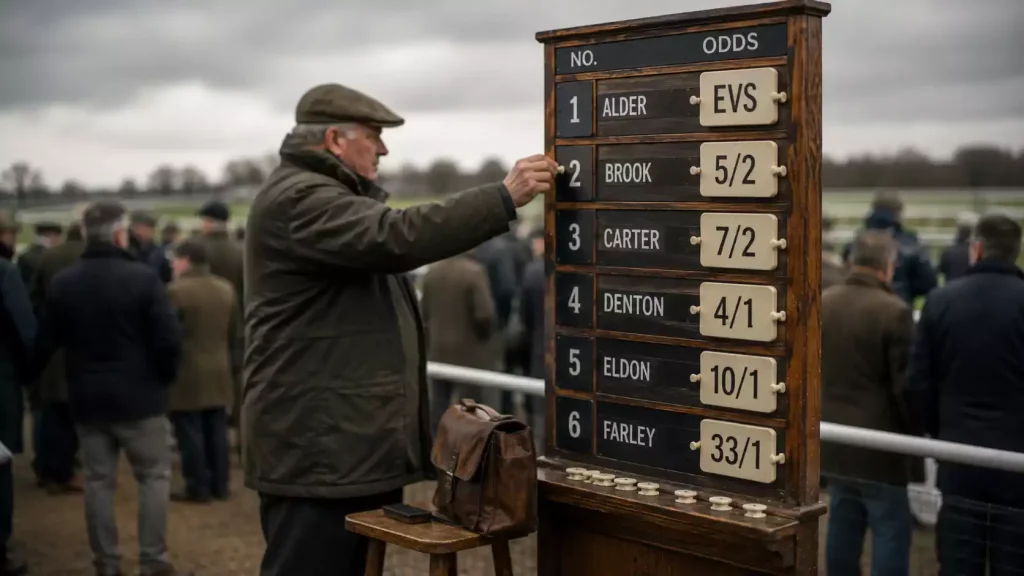
Reading fractional odds
A fraction like 4/1 reads as winnings to stake. A £10 bet at 4/1 returns £40 in winnings plus your £10 stake — £50 in your pocket if the horse passes the post first. 7/2 is three pounds fifty back for every two staked. 11/10 is eleven units back for every ten you risk. Once you internalise the format, you stop converting in your head and start feeling the price.
4/1 fractional — Stake £10. Winnings £40. Total return £50. Implied probability roughly 20 per cent.
7/2 fractional — Stake £10. Winnings £35. Total return £45. Implied probability roughly 22 per cent.
11/10 fractional — Stake £10. Winnings £11. Total return £21. Implied probability roughly 48 per cent.
Decimal odds and conversion
Decimal odds are simpler arithmetic and dominate the exchanges and most European markets. The number on the screen is your total return per unit staked, stake included. 5,0 in decimal is the same horse as 4/1 in fractions; 3,5 is 5/2; 2,1 is 11/10. The conversion is mechanical — divide the fraction, add one. Most British operators let you switch the display in your account; pick one and stick with it.
| Fractional | Decimal | Implied probability |
|---|---|---|
| 1/2 | 1,5 | 66,7 % |
| Evens (1/1) | 2,0 | 50,0 % |
| 5/2 | 3,5 | 28,6 % |
| 4/1 | 5,0 | 20,0 % |
| 10/1 | 11,0 | 9,1 % |
| 33/1 | 34,0 | 2,9 % |
Odds-on and the Frankel example
An "odds-on" price is anything shorter than even money — you stake more to win less. 1/2 means a £10 bet returns £5 in winnings. Punters new to the game often refuse odds-on as a matter of principle. Sometimes they are right; sometimes spectacularly wrong. Frankel went to post at 1/10 in the Sussex Stakes at Goodwood in 2011 and won by four lengths. The price reflects the market's confidence, not your distaste for the maths.
Frankel won fourteen races from fourteen starts and was sent off odds-on in twelve of them. Blind win-stakes on every one of his runs would have returned roughly fifty pence per pound risked. Odds-on is not the same as easy money — even when the horse is genuinely the best of his generation.
Starting price and Best Odds Guaranteed
The Starting Price, or SP, is the official price returned at the off, set by a panel of on-course bookmakers reflecting the final ring price before the gates open. Before SP arrives, you can bet at the early price — shown when you place your bet, sometimes hours or days before the race. Best Odds Guaranteed is a near-universal promotion: if you take the early price and SP drifts longer, your bet is paid at the bigger of the two. Take an early 5/1 with BOG, and if your horse drifts to 8/1 SP, your return is 8/1 — but if it shortens to 3/1, you keep your 5/1. No symmetric downside.
The Main Bet Types British Punters Use
The bet slip is where every theory meets reality. I have seen good handicappers blow a season's worth of edge by picking the wrong bet type for the right opinion — backing an outsider to win when an each-way would have paid for the trouble, or stacking a four-fold on horses none of which they would have backed singly. The bet type is part of the bet. The drill-down sits in our full guide to types of horse racing bets.
Win and each-way
A win bet is the cleanest expression in the sport — pick a horse, stake, your horse wins, you collect. An each-way bet is two bets in one — half your stake on the win, half on the place. The place portion pays out at a fraction of the win odds — typically one-fifth for handicaps of sixteen runners or more, one-quarter for smaller handicaps and non-handicaps with eight to fifteen runners. A Grand National with forty runners typically pays four or even five places under operator promotions.
Each-way on a 10/1 shot in a sixteen-runner handicap
Stake: £5 each-way — total outlay £10. Place terms: 1/5 odds, first four places paid.
Horse wins: win portion returns £55; place portion pays at 2/1 — £15. Total £70.
Horse finishes third: win portion lost. Place portion only — £15. Net £5 profit from £10 outlay.
Horse finishes fifth: full £10 lost.
Forecast and tricast
A straight forecast asks you to pick the first two home in the correct order. A reverse forecast covers both permutations. A tricast extends to the first three. Forecasts and tricasts are settled on the official dividend declared after the race — a computed payout, not a fixed price. Field size is everything.
Accumulators and multiples — Lucky 15, Yankee, Patent
British punters are unusually fond of multiples. A double combines two selections, a treble three, a four-fold four; all must win for the bet to pay. The "full-cover" family — Patent (three selections, seven bets), Yankee (four, eleven), Lucky 15 (four, fifteen), Lucky 31 (five, thirty-one) — wraps singles, doubles, trebles and beyond into a single slip. Bookmaker bonuses distort the headline payout but never close the long-run gap between the price you accept and the true probability.
The non-runner no bet rule
For ante-post bets — placed before the final declaration stage — most operators now offer "non-runner no bet" terms on major races. If your horse is withdrawn, your stake is returned. Outside those terms, an ante-post bet on a non-runner is a lost stake.
Ante-post betting
Ante-post is the long game — betting on a race days, weeks or months in advance. The attraction is the price: the early market on the Grand National or the Cheltenham Gold Cup will typically offer longer odds than you will see on the day. The catch is non-runner risk — weather, training setbacks and the chance that your horse never makes it to the start.
Tote and pool bets
Pool betting works on parimutuel maths — every stake of a given type is pooled, the operator takes a deduction, the remainder is divided among winners. The Tote operates the main pool products in Britain — Placepot, Jackpot, Scoop6 and Quadpot. The price is not visible when you bet; it is the dividend declared after the race. On big-field handicaps the Tote dividend can substantially beat the SP, particularly on outsiders.
Roughly eight per cent of punters who bet on racing stake more than £100 a month — the rest sit firmly in the recreational tier. Knowing which camp you are in shapes what bet type makes sense.
Reading a Racecard Without Drowning in Jargon
A friend asked me last summer to "have a look" at his Ascot card. He had circled three names. Two were horses that had not won in nineteen months, the third was carrying ten stone five on ground its trainer had openly said it hated. He had not read a single form figure. For the column-by-column walk-through, see our guide to reading a UK racecard; here, the literacy basics.
Form figures decoded
The string of numbers next to each horse's name — something like "2-13412" — is its recent form. Read right to left, with the most recent run on the right. A "1" is a win, "2" a runner-up, "3" a third; "0" means finished outside the top nine. A hyphen separates seasons. Letters mean trouble — "F" for fell, "U" for unseated, "P" for pulled up, "R" for refused. A horse showing "31221" has run five times, finished in the placings every time and won the most recent. A horse showing "0P000" has problems you cannot see from the paper.
Weight, draw and headgear
Weight is the great equaliser of British racing. In handicaps the BHA's official handicapper assigns weights — typically between 8 stone and 10 stone — to give each horse a theoretically equal chance based on past form. Reading weight against the same horse's previous winning weights is revealing. The draw column gives the stall number for Flat races — vital on tracks like Chester, Beverley and Goodwood where the bend favours one rail, and largely irrelevant on most National Hunt courses. Headgear codes are small letters next to the horse's name: "b" for blinkers, "v" for visor, "h" for hood, "t" for tongue tie. First-time headgear is a deliberate signal from the trainer.
Going — The official description of the ground condition. From firmest to softest on turf: Hard, Firm, Good to Firm, Good, Good to Soft, Soft, Heavy. All-weather surfaces use Fast, Standard to Fast, Standard, Standard to Slow, Slow.
Going and ground conditions
Going matters more in British racing than in almost any other major racing jurisdiction because of the weather. A Group 1 winner on Good ground at Newmarket may be all but useless on Heavy at Newbury in November. The form book records past performances by going code. A horse with three wins on Soft and a string of unplaced runs on Good is telling you exactly what it needs.
Jockey and trainer columns
The jockey column tells you who is riding and what weight allowance, if any, they claim. Apprentice riders carry a claim — three, five or seven pounds off the horse's allotted weight — until they have ridden enough winners to lose it. The trainer column tells you who has prepared the horse, and the small italicised figures next to the name typically give recent strike rate over the past fourteen days. A trainer running at twenty-five per cent over a fortnight is hot; one at three per cent is in a quiet patch. There is an ever-growing desire for this kind of data among people betting on racing, and the racecard format has barely changed to meet it — which is part of why it rewards a careful reader.
The three signals to check before any other
Code (Flat or Jumps), going against the horse's record, and recency of its last run. A horse that ticks all three is worth a closer look at price. A horse that fails any of the three is rarely worth a bet, however attractive the name in the paper.
Who Regulates the Bet You Are About to Place
An old colleague of mine left a betting shop in 2003 with a winning ticket and a vague sense that someone, somewhere, was probably keeping an eye on the place. Most British punters today are not much better informed. The bet you place this afternoon passes through three regulatory authorities before the money settles. The deeper guide sits in our piece on UK horse racing betting regulation.
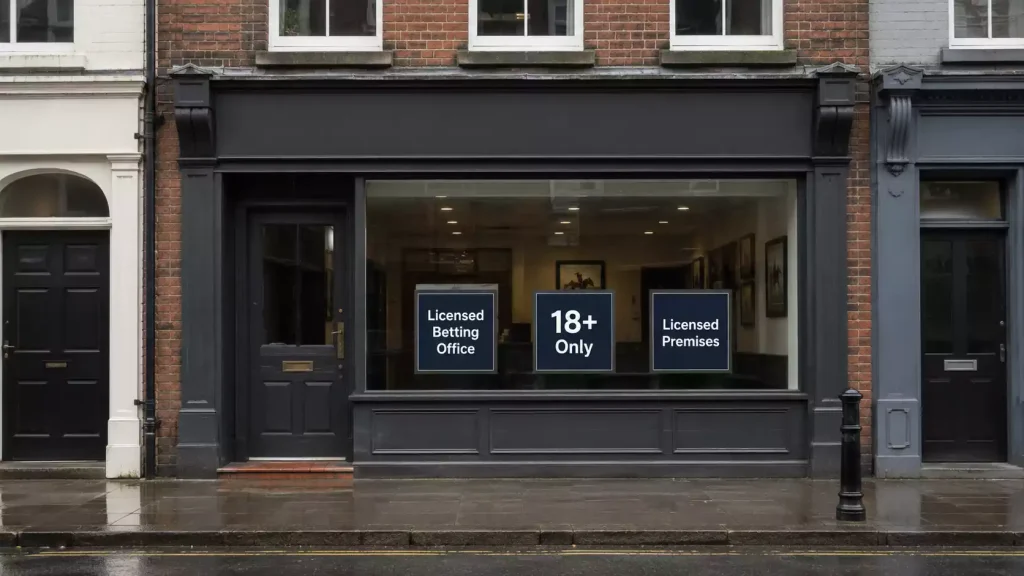
UKGC
The UK Gambling Commission licenses every operator legally taking British bets, sets the rules on advertising, AML, customer protection and dispute handling.
BHA
The British Horseracing Authority governs the sport itself — rules of racing, integrity investigations, racecourse licensing, handicapping.
HBLB
The Horserace Betting Levy Board collects the statutory Levy from bookmakers and redistributes it to prize money, integrity and welfare.
UK Gambling Commission and licensing
The UKGC is the gatekeeper. At the end of March 2025 there were 3 086 active licensed gambling operations in Britain and 5 825 betting shops on the high street. Every legal operator displays its UKGC licence number in the footer of its website, and the public register is searchable. If a site is taking your money and you cannot find a UKGC licence, you are not in the regulated market — no recourse if the operator goes bust, no protection on your balance, no independent dispute resolution.
British Horseracing Authority and the rules of racing
The BHA does not regulate your bet, but it regulates everything your bet is wagered on. It sets the rules of racing, licenses trainers and jockeys, runs integrity investigations and decides the handicap weights. Its chief executive Brant Dunshea took the role on a permanent basis in 2026 and was unusually direct — "it is no secret that the sport has experienced a challenging period as it faces up to the process of change at a governance level, but I want to be clear that this has not stopped the BHA and the industry making important progress to safeguard the long-term health of British racing."
Horserace Betting Levy explained
This is the bit British punters tend not to know exists. By statute, bookmakers pay ten per cent of their gross profits on British horse racing back into the sport, above a threshold of £500 000 of annual profit. In 2024–25 the Levy yield reached £108,9 million — the highest since 2017. Of the 2024 spend, £66,9 million went to prize money, £19,4 million to regulation and integrity, £7,9 million to staff recruitment and promotions, and £2,3 million to veterinary research. Your legal bet contributes to the prize fund of the next race you watch.
Why the Levy matters to a punter
Anne Lambert, interim chair of the HBLB, has been pointed about the strain underneath — "we will exercise appropriate prudence in expenditure decisions and maintain sufficient reserves as bookmakers' increased profits are being generated from falling turnover." A record Levy yield from falling stakes is not a healthy combination.
Affordability checks in 2024 to 2026
This is the live wire of the moment. From August 2024 the UKGC's financial-vulnerability framework set the trigger for assessments at net monthly deposits of £500 per customer; from February 2025 that threshold dropped to £150. The Commission has said roughly three per cent of active accounts fall under these higher-risk thresholds. The Jockey Club's former chief executive Nevin Truesdale framed the concern bluntly — "the Gambling Commission seems to want to reduce gambling to just small-stakes gamblers and that can't be right." The practical effect is concrete — frequent middle-stakes deposits can prompt an operator to request information.
One related figure. Yield Sec estimates unlicensed operators control around nine per cent of online gambling activity in Britain — roughly £379 million in gross gambling yield across the first half of 2025, with an annual unlicensed wagering total around £2,7 billion. The BGC's chief executive Grainne Hurst has called them "parasite operators" who "don't pay tax, don't care about safer gambling, and do not contribute a penny to the levy." Every pound staked outside the licensed market is a pound that does not feed the sport and does not protect you.
Value, Bias and Why Favourites Are Not Free Money
Here is the conversation I have had more times than any other in ten years. Punter walks up, points at the morning paper, says, "this one's bound to win." The horse is 2/5 in a six-runner Group race, and he wants to know if he should "lump on." I always ask the same question — does the price represent the true probability, or just a strongly held opinion? Nine times out of ten, the answer is the second.
What value actually means
Value in betting has nothing to do with whether a horse is "good" — it has to do with whether the price on offer overstates or understates its actual chance. If a horse's true probability of winning is 25 per cent and the bookmaker is offering 4/1, that is fair. If the same horse is on offer at 5/1, that is value. If at 7/2, that is overpriced. The maths is brutal: you do not win in the long run by picking winners, you win by picking prices.
The favourite-longshot bias
This is the single most replicated finding in betting research. Stefan Winter and Martin Kukuk summarised it in the Schmalenbach Business Review in 2007 — "empirical studies of horse race betting in the U.S., the UK, and Australia have established the so called favorite-longshot bias. Studies find that on average, bets on longshots lose much more than do bets on favorites." Blind betting on favourites in UK and Irish racing produced roughly minus 7,18 per cent return on investment across a ten-year sample. Blind betting on the ninth or tenth favourite produced losses of forty per cent or more. Snowberg and Wolfers's 2010 paper in the Journal of Political Economy explained the effect through misperceptions of probability rather than punters genuinely loving risk.
Overround and the bookmaker's margin
Every price on a board adds up to more than 100 per cent of probability. That excess is the overround — the bookmaker's built-in edge. On a typical Group race the overround might be five to eight per cent above 100; on a competitive twenty-runner handicap it can drift into double figures. Add up the implied probability of every price on the board: if the sum is 108 per cent, the bookmaker has built in eight points of margin. The exchange model — where punters back and lay against each other — operates on a much tighter margin, because the exchange charges commission on net winnings rather than embedding it in the price.
Do
- Check the overround on every market — fewer runners and tighter overround usually means a sharper price.
- Compare the early price to SP movements on similar horses.
- Take Best Odds Guaranteed when it is offered; it is a one-way concession in the punter's favour.
Don't
- Bet a horse just because the price looks "big" — bigger prices reflect lower probabilities, often by more than they should.
- Chase losses by stepping up to longshots; the bias means the price is moving against you.
- Treat odds-on as charity — Frankel returned ten pence per pound for a reason.
Value requires holding two opinions simultaneously — yours about the horse, and the market's about the price. If you cannot articulate why your opinion is better-informed than the market's, you are not finding value, you are confirming bias.
The Festivals That Define the British Calendar
Cheltenham in mid-March empties the offices of half the country. Aintree in early April fills the betting shops with people who have not been inside one since the previous Grand National. Royal Ascot in June puts top hats and morning suits next to high-rolling international owners, and Epsom on the first Saturday of June crowns the year's best three-year-old colt. These four meetings carry the rhythm of the British betting year.
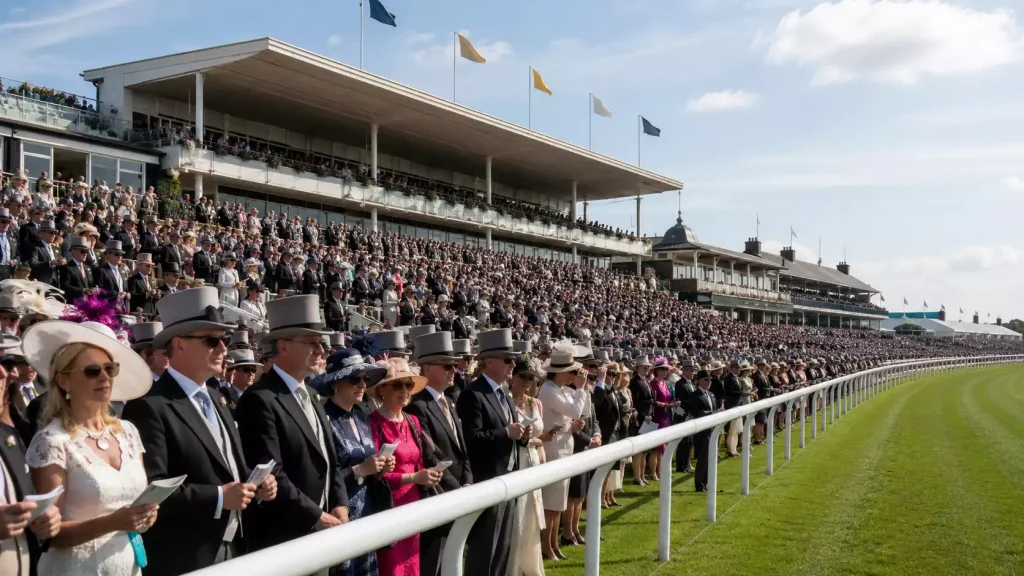
Cheltenham Festival
Four days in March, twenty-eight races, the peak of National Hunt. Average daily attendance 60 583. The Gold Cup on Friday is the championship of jump racing's championship code.
Grand National
Three days at Aintree culminating in the world's most famous steeplechase on the first Saturday of April. Average daily attendance 42 775. The race drew roughly £250 million in stakes in 2025 and a global audience around 600 million viewers across 140 countries.
Royal Ascot
Five days in June, eight Group 1 races across the week. Average daily attendance 54 984. The most international meeting of the British year.
Epsom Derby
Two-day meeting on the first Friday and Saturday of June. The Derby is the classic for three-year-old colts over a mile and a half on Epsom's switchback contours — arguably the hardest course on the Flat to read.
The concentration of money at these festivals is extraordinary. All twenty-eight Cheltenham Festival races in 2025 landed inside the top thirty-one of the season for betting turnover — a single four-day meeting accounting for almost the whole top tier of the year's betting product. The Grand National pulls in punters who otherwise never bet — surveys put adult participation at 49 per cent of British adults staking something on the race in 2025, with 73 per cent of those aged 55 and over planning a punt against just 19 per cent of 18 to 24-year-olds.
The 1839 running at Aintree is generally treated as the first official Grand National. The race is now older than the Football Association by twenty-four years, older than Wimbledon by thirty-eight, and older than the modern Olympic Games by fifty-seven.
The practical implication of festival weeks is the price. Cheltenham markets shorten dramatically in the morning as casual money piles into a handful of obvious horses. Overrounds widen on the big handicaps. Best Odds Guaranteed becomes genuinely valuable — taking an early price the night before is often the difference between a viable bet and a loser.
Betting Without Losing What You Cannot Afford
Two punters I knew at the start of my career are not betting any more. One stopped because he developed the discipline to walk away. The other stopped because he had no money left. The difference between them was not luck or skill — it was how seriously they took the question of "what can I afford to lose this month" before they ever opened a betting app.
Setting limits before you start
Every UKGC-licensed operator is required to offer deposit limits, loss limits, session limits and reality checks within the account. Setting them is a thirty-second job and most punters never do it. The principle: decide your monthly cap when you are not in a betting mood, not on the morning of a race. If you want to raise it, the operator imposes a cooling-off period before the increase applies; if you want to lower it, the change is immediate. The asymmetry is deliberate and it is on your side.
GamCare, GAMSTOP and BeGambleAware
Three independent resources exist for any British punter who suspects their betting has stopped being recreational. GamCare runs a 24-hour helpline — in 2023–24 they reported 67 per cent of callers were dealing with debts caused by gambling and 76 per cent reported financial hardship. GAMSTOP is the national self-exclusion scheme: a single registration blocks your access to every UKGC-licensed gambling site and app for the period you choose, from six months to five years. BeGambleAware funds research and treatment services and runs the National Gambling Helpline. None of these services costs you anything.
Spotting harmful patterns
The classic warning signs are unflashy and easy to miss in yourself. Chasing losses — increasing stakes after a losing run. Betting when you would not normally bet. Hiding bet history from family. Using funds earmarked for something else. The published baseline: 0,5 per cent of British adults show problem gambling behaviour and 3,8 per cent sit at the "at-risk" tier, with the Health Survey for England previously putting the problem-gambling rate among people who bet on racing at 2,8 per cent. Most British punters bet small and stop on time. The difference is awareness and habit.
Three quick checks before you raise a stake
- Would I be comfortable telling someone close to me exactly how much I have staked this month?
- Am I betting because I have an opinion, or because I want to feel something change?
- If I lose this stake, does anything else in my budget bend? If yes, the stake is too big.
A Practical Pre-Bet Checklist
If everything above is the theory, the checklist below is what you actually use on your phone in the betting shop or on the train to Sandown.
I keep my own version of this on a folded card in the wallet. After ten years it is habit — but the habit was built on this exact sequence, in this exact order, and I drop straight back to it whenever a meeting feels chaotic or a price feels too good to be true.
Seven checks before you click confirm
- Confirm the operator's UKGC licence number is visible on the site or app. Without it you are betting in the unregulated market.
- Decide win or each-way before you look at the price. The bet type follows from your opinion on the horse, not from the size of the field.
- Check the going and compare it to the horse's record. Three wins on Soft and an unplaced run on Good tells you what the horse actually wants.
- Check the form figures right to left. The most recent run is the most informative — particularly the gap since the last outing and the finishing position.
- Look at the price against your own estimate of probability. If you cannot estimate, walk away — you are betting on instinct, not value.
- Confirm Best Odds Guaranteed is active on the bet. If it is, the early price is a free option.
- Set or check your monthly deposit limit before staking. The thirty seconds it takes is the cheapest insurance in the sport.
The checklist is not a method for finding winners. It is a method for not finding losers — for filtering out the bets that, with hindsight, you would never have placed if you had stopped for thirty seconds. The gap between a recreational punter and a serious one is not opinion-quality but discipline.
Frequently Asked Questions
How do horse racing odds work in the UK?
British odds default to fractions and read as winnings to stake. A bet of £10 at 4/1 returns £40 in winnings plus the original £10 stake — £50 in total. Decimal odds, used on exchanges and across Europe, show your total return per unit staked including the stake, so 4/1 is the same as 5,0 decimal. Most online operators let you toggle the display in your account, but on-course boards and the racing press in Britain still default to fractions.
What is the difference between a win bet and an each-way bet?
A win bet pays out only if your horse passes the post first. An each-way bet is two bets in one — half your stake on the win, half on the horse to place. The place portion pays out at a fraction of the win odds — typically one-fifth or one-quarter depending on field size and race type. An each-way doubles your outlay but cushions the outcome; it makes sense on horses where a place finish is plausible but a win is not certain. On odds-on favourites it is almost never worth it.
Why does a UKGC licence matter when I bet on horses?
A UK Gambling Commission licence is the threshold of consumer protection. Licensed operators ringfence customer funds, follow anti-money-laundering rules, provide independent dispute resolution and contribute to the statutory Horserace Betting Levy that funds prize money, integrity and welfare. An unlicensed operator does none of these. Unlicensed operators are estimated to control roughly nine per cent of online gambling activity in Britain, so the question is not academic.
What is Best Odds Guaranteed and is it worth chasing?
Best Odds Guaranteed, or BOG, is a near-standard promotion on UK racing in which an operator pays the bigger of two prices — the price at which you took your bet or the Starting Price returned at the off. If the SP shortens, you keep the bigger early price; if it drifts longer, you collect the bigger SP. There is no symmetric downside, which makes BOG a one-way concession to the punter. It is genuinely worth taking when available.
Is online horse racing betting legal in the UK in 2026?
Yes, online horse racing betting is legal for adults aged 18 and over, provided the operator holds a UK Gambling Commission licence. The Commission's register is public and the licence number appears in the footer of every legal operator's site. Affordability checks have become more intrusive — net monthly deposits over £150 can trigger a financial-vulnerability assessment under current UKGC policy. The bet itself remains entirely legal; the supporting documentation requirements have tightened.
What does the going tell me before I place a bet?
Going is the official description of the ground condition and it matters more in Britain than in almost any other major racing nation. The scale runs from Hard and Firm at the dry end through Good to Firm, Good, Good to Soft, Soft and Heavy at the wet end on turf. All-weather surfaces use their own scale from Fast to Slow. A horse's previous winning runs are often clustered around a specific going code. Reading the going against the horse's record is the single most informative thirty seconds you can spend on a racecard.
What changed with affordability checks in 2024 and 2025?
Two thresholds shifted in succession. From August 2024 the UKGC set the trigger for financial-vulnerability assessments at net monthly deposits of £500 per customer. From February 2025 that threshold dropped to £150. Roughly three per cent of active gambling accounts now fall under these higher-risk thresholds. The practical effect for a regular middle-stakes punter is that frequent deposits in the £200 to £500 range can prompt an operator to request information about your finances.
Where to Go From Here
The map ends here, but the country it describes is still being redrawn — by the regulator, by the operators, by the betting public, and by the sport itself.
Everything in this guide is the foundation. Once you have the codes, the odds, the bet types, the racecard and the regulatory shape clear in your head, the deeper pieces in this project land properly. Without the foundation those become noise; with it they become useful.
British racing in 2026 is at a more interesting inflection point than at any time I can remember. Brant Dunshea, taking the BHA chief executive role on a permanent basis this year, said the sport has experienced a challenging period of governance change but that this has not stopped the industry making progress to safeguard its long-term health. The sport is still here, the regulatory framework is still working, the prize money is still flowing back from your legal stakes, and the questions worth answering are the ones any thoughtful punter should be asking — what is my edge, what is my bankroll, what is my limit, who am I betting with.
Bet with a UKGC-licensed operator, in stakes you have decided in advance, on opinions you can articulate against the market price. Everything else in this guide is a refinement of those four things.
Payments
Created by the "" editorial team.