
Best Odds Guaranteed: How BOG Actually Works
Best Horse Racing Betting Sites – Bet on Horse Racing in 2026
 Available in US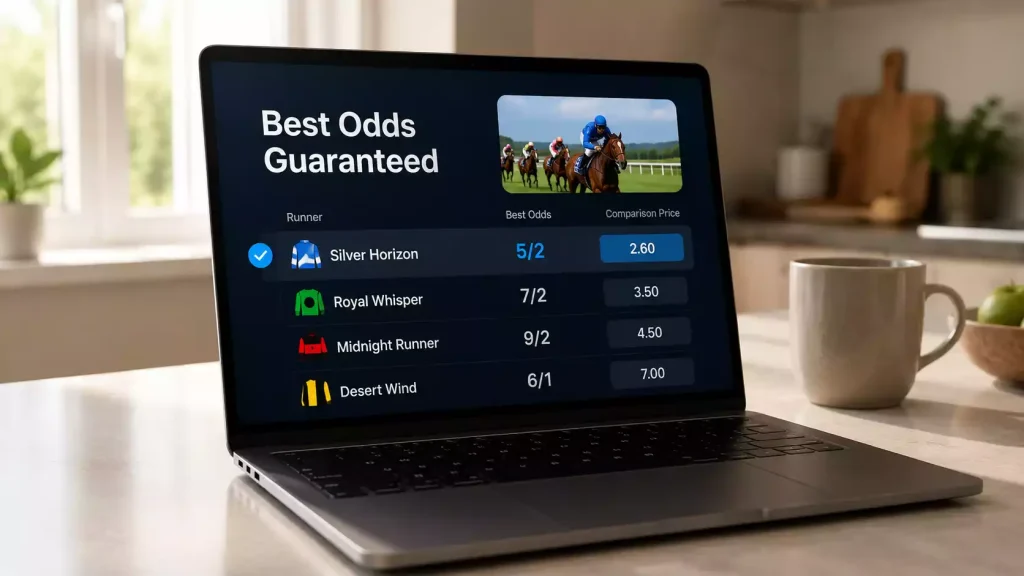
The Only Promo That Pays Its Way
Most bookmaker promotions are theatre. Free bets with rollover requirements that bury the value, “bet £10 get £30” offers that need a six-leg accumulator to clear, “money back if your horse finishes second” stunts that quietly exclude every race you would actually back. After ten years watching these mechanics, I have come to a simple test: a promotion either has a mathematical reason to exist or it does not. Best Odds Guaranteed is one of the few that does.
BOG hands the punter a free option – the better of two prices on the same horse, the price you took and the starting price. No rollover, no minimum stake, no qualifying-bet requirements beyond the basic deposit and turnover terms a regulated UK operator is going to apply anyway. That alone makes it the single promotion worth structuring your day-of-race betting around, and it explains why every serious British firm has had to offer it for the past decade just to remain credible in the racing market.
How the prices themselves are set: horse racing odds.
How BOG Pays Out
Here is the basic mechanic. You back a horse at, say, 5/1 in the morning. The race goes off in the afternoon. The starting price returned by the SP system – the official price compiled from a sample of on-course bookmakers at the moment the stalls open – turns out to be 7/1. If you have a BOG-eligible bet, the bookmaker pays you at 7/1, not at the 5/1 you originally took. If the SP comes back at 4/1, you still get paid at the 5/1 you took. Heads you win, tails you also win. That is the option.
The settlement happens automatically – well, automatically at most firms. Some operators apply BOG silently in the background and your account just shows the better price; others post the bet at your taken price and then apply a “BOG bonus” credit when the SP returns higher. Functionally identical, presentationally different, and worth knowing which mode your account is in so you can read your bet history correctly.
The economic logic from the bookmaker side is straightforward. Horse racing in the UK financial year to March 2025 generated £766.7 million in remote betting gross gambling yield – the second-biggest betting product in the country after football. Racing punters are price-sensitive. A bookmaker that does not offer BOG on win and each-way bets is, for that segment, simply uncompetitive. The cost of paying out the upside drift on the minority of bets that drift is more than recovered through the volume of bets that punters route to BOG-offering firms instead of competitors.
The Timing Window
BOG is not a 24-hour offer. It has a window, and the window is where most punters get bitten. The standard activation point at British operators is the day of the race, with most firms switching BOG on between 8:00 and 9:00 in the morning. Some open at 8:30, some at 9:00 sharp. A few enable it from the previous evening on the next day’s racing. None – that I have ever seen – apply BOG retroactively to bets placed earlier in the antepost cycle.
Why this matters: an ante-post bet placed three weeks before the race at 10/1 will not become a BOG bet on the morning. It stays at the price you took, with no upside protection if the horse drifts at the off. If you want BOG, you have to wait until the morning window opens. The trade-off is obvious – you might get a better price by waiting, you might also get a much shorter one if the market hardens overnight. There is no universal right answer, only the situation in front of you.
The closing edge of the window is the off itself, the moment the stalls open. After that, the SP is fixed and BOG is settled. Bets placed during in-running markets are a separate animal – most firms do not extend BOG to in-play bets, because the concept of a “starting price” no longer applies. Read the specific terms on whichever account you are using. The rules are firm by firm, not universal.
BOG on Each-Way Slips
Each-way bets sit awkwardly inside the BOG framework, and the way the awkwardness resolves varies between bookmakers. The principle should be clean: BOG applies to the win half and the place half independently, because both halves are settled against the SP and place terms. In practice, most firms do apply BOG to both halves, but the place half is paid at the BOG fraction of the BOG-adjusted SP, which is a sentence that needs unpacking.
Take a 6/1 morning price with one-quarter place terms, three places. The horse drifts to 8/1 SP. The BOG-adjusted price for the win half is 8/1. The BOG-adjusted place half is one-quarter of 8/1, which is 2/1. If you had stuck with the morning 6/1, the place half would have paid at 6/4 – that is 1.5/1. The BOG upgrade on the place half is real, and on a £10 each-way slip it changes the place collect from £25 winnings to £30 winnings. Modest in isolation, but across a season of placed horses it adds up.
A small minority of operators apply BOG only to the win half, which is a meaningful clip you should know about. Check the specific terms before relying on the calculation. If you bet each-way regularly and your firm only BOGs the win half, you are leaving real money on the table over time.
The full picture is in our guide to UK horse racing betting basics.
What Bookmakers Differ On
The headline mechanic is broadly the same across regulated UK operators, but the small print is where the operators differentiate themselves – and where punters get caught. The variations matter.
Some firms cap BOG payouts above a certain margin between taken price and SP. So if your 4/1 horse comes in at 16/1, the firm might cap the payout at 8/1 or 10/1 rather than the full SP. This is rare among major operators but exists, and the cap is usually buried in the terms.
Some firms exclude BOG on certain race types. Antepost is always excluded, as already covered. Forecasts and tricasts are usually excluded because they settle on a different basis. Multiples that include a non-BOG-eligible leg often lose BOG on the qualifying legs too – read the terms on Lucky 15 and Yankee bets carefully.
Stake caps are another variation. A firm might apply BOG only up to a certain stake per bet, with anything above that capped at the morning price. The caps are typically in the £25 to £100 range and usually correspond to the firm’s policy on bet maximums for high-volume customers.
One BHA director put the structural issue plainly: “Total betting turnover has fallen by nine per cent compared with the same period in 2024. Whilst there is work to be done on the racing product to grow its appeal as a betting medium, there would be a much wider range of factors contributing to this concerning decline.” When the headline turnover is shrinking, bookmakers tighten the discretionary giveaways – and BOG terms are one of the first places where the tightening shows up. If your favourite firm has quietly reduced its BOG generosity, that is the macro picture working through to your account.
The Exclusions That Catch People
The races where punters most expect BOG are the races where it is most often quietly excluded. The Grand National is the obvious case. Almost every major British firm runs special place terms, special enhanced odds, special early-price guarantees on the National – and many of them switch BOG off for that race entirely, or apply it only above the regular SP and not above the enhanced morning prices. The logic is brutal but reasonable from the bookmaker side: the National is the only race in the year where the public bets in volume that dwarfs the regular market. £250 million was wagered on the 2025 running, watched by an estimated 600 million viewers across 140 countries. The firm cannot afford to BOG that scale of action against a typically drifting field.
Other common exclusions: ante-post bets, as covered. Bets placed via certain promotional codes or free-bet tokens. Bets on overseas races where the UK SP-equivalent mechanic does not apply. Bets that combine racing legs with non-racing legs in a multiple. Special markets like “without the favourite” or “to be placed” pools.
The pattern across all these exclusions is the same: BOG applies to standard, single-leg, day-of-race win and each-way bets at standard SP. Anything that deviates from that template is potentially excluded. The rule of thumb I use is to assume BOG does not apply unless the bookmaker explicitly flags that it does – usually with a small “BOG” badge next to the price on the betting form. No badge, no guarantee.
Does Best Odds Guaranteed apply to bets placed on the Grand National?
Most major UK bookmakers either suspend BOG entirely on the Grand National or apply it only above the standard SP, not above their own enhanced morning prices. The exclusion is almost always disclosed in the small print of the firm"s Grand National promotion. Always check the specific terms before backing, because the rules vary between operators and from year to year.
What is the difference between automatic and manual BOG settlement?
Automatic BOG means the bookmaker applies the better of the two prices in the background, and your bet history simply shows the final price you were paid. Manual BOG means the bet is settled at your originally taken price, and the difference is then credited to your account as a BOG bonus, usually within minutes of the race result. Both produce the same return, but manual settlement is easier to audit because you can see the upgrade explicitly on your account history.
If you want to dig deeper into how the SP itself is compiled and how it relates to the prices on the morning board, the broader mechanics are covered in the piece on how UK horse racing odds work and what the numbers actually mean. BOG is one promotion built on top of that pricing layer; understanding the layer beneath makes the promotion sit in context.