
Favourite-Longshot Bias in Horse Racing
Best Horse Racing Betting Sites – Bet on Horse Racing in 2026
 Available in US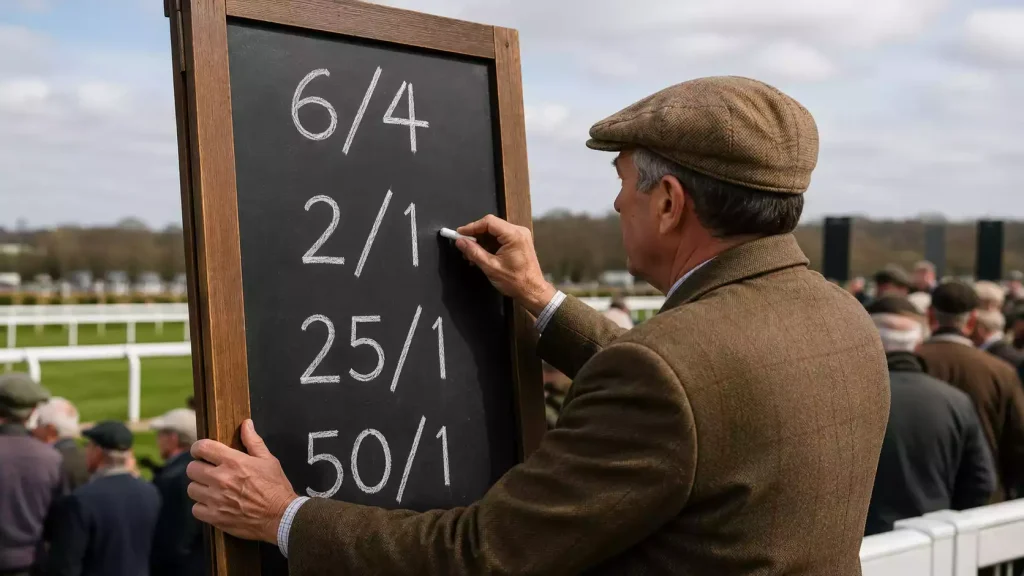
The favourite-longshot bias is one of the most stubborn empirical effects in the entire literature of sports betting. It says, in plain language, that bets on favourites lose less money over the long run than bets on outsiders – and the gap is wide enough to be visible in any dataset of meaningful size. Both groups lose money on average, because the bookmaker margin guarantees it, but the rate of loss on long-priced horses is dramatically worse than on the front of the market. This isn’t a hunch or a punter’s superstition. It has been measured in the UK, US and Australia, replicated across decades, and explained by behavioural economists in peer-reviewed journals.
The reason this matters for you, as a punter, is that the bias is one of the rare quantitatively confirmed market inefficiencies in any betting market. Most “edges” in horse racing are subjective or context-dependent. The favourite-longshot bias is neither. It is a structural property of how punters price horses, and once you understand the mechanics, you can decide where you want to sit relative to that structure. Anyone betting blindly on long-priced outsiders week after week is doing more than gambling; they are participating in a documented loss pattern.
Turning a price into a probability: value betting.
What the Research Shows
The bias was first identified in academic literature in 1949, in a paper analysing US thoroughbred betting markets, and it has been replicated more times than almost any other finding in financial economics. The core empirical claim is straightforward: if you group every horse in a dataset by starting price band – favourites, second favourites, third favourites, all the way out to 50/1 and longer – and you calculate the average return on a level stake, the loss rate rises monotonically as the prices lengthen. Short-priced horses lose a little. Long-priced horses lose a lot. The relationship is consistent across countries and decades.
Winter and Kukuk, writing in Schmalenbach Business Review in 2007, summarised the international evidence: “Empirical studies of horse race betting in the U.S., the UK, and Australia have established the so called favorite-longshot bias. Studies find that on average, bets on longshots lose much more than do bets on favorites.” That sentence, simple as it reads, is the foundation of a body of work spanning more than seventy years.
The numbers from the UK and Irish markets specifically tell a striking story. A blind level-stake bet on every favourite in UK and Irish racing over a ten-year window produces roughly a 7.18% loss on stakes – meaning for every £100 staked across the strategy, you finish around £93 down. That is bad, but bearable for a recreational punter. The same level-stake bet on every ninth or tenth favourite in the market produces losses of 40% or more over the same window. The two strategies are not in the same ballpark.
The effect persists across race types, distances, codes and going descriptions. It is observable on the Flat, over jumps, in handicaps and in conditions races. It is a feature of how the market prices, not a quirk of any particular race category.
The Theories Behind It
Two main schools of thought explain why the bias exists. Both are well-supported, and the modern consensus is that they are complementary rather than competing.
The first explanation is “risk-love” – the idea that punters derive utility from the act of taking long-shot positions, independent of the expected financial return. Backing a 50/1 horse is, for many punters, a different kind of experience from backing the favourite. There is a hopeful narrative, an entertainment value, a small ticket to a large dream. That experiential value is real, and punters effectively pay for it by accepting worse expected returns on long prices than on short ones. The bookmaker, recognising this preference, prices accordingly – and the bias is the market clearing the demand for long-shot tickets.
The second explanation, advanced most rigorously by Snowberg and Wolfers in the Journal of Political Economy in 2010, is that punters systematically misperceive small probabilities. People are bad at distinguishing a 1-in-30 chance from a 1-in-50 chance – both feel like “a long shot” and get treated similarly even though their true expected values differ significantly. When the public overestimates the chance of long-priced horses winning, the prices on those horses get bid shorter than they should be, and the implied probability exceeds the true probability. The result is a structurally negative expected value on every long-shot bet.
The Snowberg and Wolfers analysis is important because it shifts the explanation from preferences (people want the risk) to cognition (people can’t accurately price the risk). The two explanations coexist comfortably – punters both enjoy long-shot tickets and price them badly – but the cognitive explanation makes the bias predictable and persistent in a way that preference-based explanations don’t.
The implication for behavioural punting is meaningful. If the bias were purely about preferences, you could expect it to vary widely between punter populations. The cognitive explanation predicts that the bias will appear consistently in any large betting market – which is exactly what the empirical work has found.
The UK-Specific Numbers
British and Irish racing have been particularly well-studied because the markets are old, the data is publicly accessible, and the price structures have remained relatively stable across decades. The most-cited finding for UK punters is the 7.18% loss rate on blind favourite betting across a ten-year sample. That figure is consistent with what bookmaker margins should produce, suggesting the favourite end of the market is priced approximately efficiently after costs.
The picture deteriorates rapidly as you move down the price ladder. Second favourites show somewhat higher losses than favourites. Third and fourth favourites are worse again. By the time you reach the seventh or eighth favourite in a typical British handicap field, the level-stake ROI is deep into double-digit negative territory. By the ninth and tenth favourites – usually horses priced 25/1 and longer – losses regularly exceed 40% of stakes.
The pattern interacts with race type. Large-field handicaps amplify the bias because there are more long-priced horses in each race, and the market disperses its mispricing across more runners. Small-field conditions races compress the bias because there are fewer outsiders for the public to misprice. Group 1 races in particular tend to have efficient prices on the major players and significant losses concentrated in the rank outsiders who shouldn’t really be in the race.
The Grand National is the extreme case. A field of 34 runners, intense public engagement, and a high proportion of bettors who back horses by name or colour rather than form – those conditions produce a particularly sharp bias, with the very long prices (100/1 and beyond) routinely showing implied probabilities well above their actual win rates. The high-profile nature of the race draws in casual punters whose pricing intuitions are poorly calibrated, and the bookmaker margin on those bets reflects that.
The full picture is in our guide to UK horse racing betting basics.
Practical Takeaways
The first takeaway is structural: do not, under any circumstances, bet blindly on long-priced outsiders. The expected return is materially worse than the expected return on shorter prices, and over any meaningful sample of bets the difference is enough to determine whether you finish the year quietly down or significantly down. Long-shot betting is the most expensive form of recreational punting, full stop.
The second takeaway is more nuanced. The bias does not mean that backing favourites is profitable – they still lose 7.18% on average, which is a real loss. What the bias means is that the favourite end of the market is approximately efficient after costs, while the long-shot end is significantly inefficient. If you want to bet on outsiders, you need a positive reason – a specific edge in your reading that overrides the structural disadvantage – rather than the absence of a negative reason. “I fancy this one at 33/1” is not an analysis; it is a participation in the bias.
The third takeaway is operational. Several strategies attempt to exploit the bias profitably, and most of them fail in practice because the bookmaker margin absorbs the structural advantage. The most credible approach is “value betting” – backing horses whose price is longer than their true probability of winning, regardless of where they sit in the market – but this requires an ability to estimate true probability that most punters don’t have. For a deeper walk-through of how to think about value as a punting concept, see our guide to value betting in horse racing.
The fourth and most important takeaway is psychological. The favourite-longshot bias persists because punters keep producing it. Every casual bet on a 50/1 shot at Royal Ascot reinforces the pricing pattern. Knowing about the bias is not the same as being immune to it – the cognitive misperceptions that drive long-shot pricing apply to you and me as much as to anyone else. The only reliable defence is procedural: a betting routine that forces you to make an explicit case for each long-shot selection rather than backing on instinct.
FAQ
Does the favourite-longshot bias mean favourites are always good bets?
No. Favourites still lose money on average over the long run, at roughly the bookmaker margin rate. The bias means favourites lose less than outsiders, which is a relative claim about market efficiency rather than an absolute claim that favourites are profitable. Blind favourite betting is a losing strategy, just a less heavily losing one than blind long-shot betting.
Does the bias work the same way in all racing markets?
It has been confirmed in the UK, US and Australia, and broadly replicated in other markets. The strength of the bias varies – generally it"s more pronounced in markets with high participation from casual punters, and less pronounced in markets dominated by professional money. UK racing sits roughly in the middle of the international spectrum.
Can betting exchanges eliminate the favourite-longshot bias?
Exchanges reduce but don"t eliminate the bias, because the same cognitive misperceptions that produce it among bookmaker customers also affect exchange users. Exchange prices are generally tighter and more efficient than bookmaker prices, particularly at the favourite end, but research has found a residual long-shot bias on exchange markets too, especially in retail-driven races.
Reading the Bias into Your Own Behaviour
The favourite-longshot bias is, in a sense, a mirror. It tells you that the way most punters look at long prices – with optimism, with hope, with under-calibrated probability estimates – is reliably wrong. The question for any serious punter is whether their own long-shot bets sit inside that pattern or outside it. If you can’t articulate a specific reason a 33/1 horse is mispriced, you are almost certainly participating in the bias rather than exploiting it. The most valuable use of this knowledge is not to find a clever strategy that beats the market. It is to stop placing the bets that the market relies on you to keep making.