
Forecast and Tricast Bets in UK Horse Racing
Best Horse Racing Betting Sites – Bet on Horse Racing in 2026
 Available in US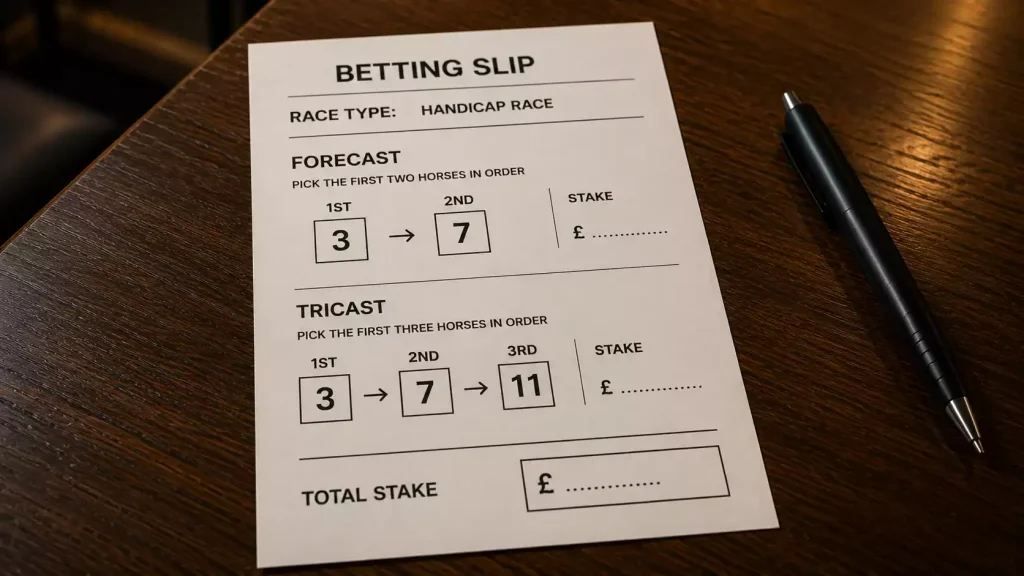
The Hardest Singles in the Book
A friend who has been punting for thirty years has a simple rule: he will not place a forecast unless he has been to the parade ring and watched the two horses walk. Not seen them on TV – watched them in person. Until you appreciate just how hard it is to pick the first two home in a 12-runner handicap, the rule sounds like superstition. Spend an afternoon trying to do it and the rule starts to sound like wisdom.
A forecast asks you to predict the first two finishers in the correct order. A tricast asks for the first three in the correct order. These are mathematically among the toughest single bets in the British betting menu, and they exist as a structural counterweight to the win and each-way markets – a place where the bookmaker can absorb sharp money on the favourite without giving anything back, because the additional layer of “in the correct order” multiplies the difficulty in ways that overround on simple win markets simply cannot match. The total betting turnover on British racing fell 4.2 % year-on-year to Q3 2025 and is down 12.8 % against 2023; in that environment, the bookmaker margins on forecasts and tricasts are not getting easier on the punter.
The full menu of bets: types of horse racing bets.
Straight Forecast
The straight forecast is the simpler of the two. You select two horses from the field and predict that they will finish first and second in the order you have specified. Horse A wins, Horse B is second, slip wins. Any other outcome – including A finishing first and B finishing third, or A finishing second and B winning – and the slip loses.
Forecasts are settled differently from win and each-way bets. There is no displayed price at the time you place the bet. Instead, the dividend is calculated after the race using a formula called the Computer Straight Forecast, or CSF. The dividend depends on the SP of the two horses involved and on a deductive parameter applied to the entire race. The published dividend is what one £1 stake on the straight forecast returns, including the £1 stake. So a CSF dividend of £15.50 on your forecast means a £1 bet collects £15.50.
This pricing model has a couple of consequences punters should grasp. First, you cannot lock in a price the way you can with a win bet. The CSF is calculated post-race based on the final SP returned, so you are taking exposure to whatever the eventual dividend turns out to be. Second, the CSF formula is opaque to most punters in its precise mechanics, but it broadly reflects the implied probability of the two SP-priced horses finishing in that order, with the bookmaker’s overround layered on top. A “fair” CSF would equal the product of the win prices times an adjustment for the second-place probability; the actual CSF embeds a meaningful margin above that fair value.
The practical implication is that forecasts on shorter-priced horses can return dividends that look surprisingly modest. A forecast on the 2/1 favourite and the 4/1 second favourite might pay out around £8 to £12 per £1 stake – a long way from the £20 to £30 that the casual calculation of “2 × 4 = 8, with overround” would suggest, because the actual probability of those two horses finishing in that exact order is higher than the product of their independent win probabilities. Forecasts on longshots, by contrast, can return CSF dividends in the hundreds or thousands.
Reverse Forecast
The reverse forecast is two straight forecasts combined: one with selection A first and B second, and one with B first and A second. Two lines, two unit stakes, double the cost. A £1 reverse forecast costs £2. The slip wins if A and B finish first and second in either order, with the dividend calculated against whichever order they finished.
The reverse forecast is the structure most casual punters actually want when they say “forecast.” If you fancy two horses to finish first and second but have no strong view on which will win, the reverse forecast lets you collect on either outcome. The cost is the doubled stake, which is a meaningful drag on expected value but also a reasonable insurance premium against the 50/50 question of who finishes ahead.
A specific situation where reverse forecasts shine is the small-field race. In a six- or seven-runner race where you can confidently identify two horses as standout chances, the reverse forecast becomes a viable structure – there are not many combinations, the probabilities of one of the two ordered outcomes are reasonable, and the dividends on small-field forecasts can be meaningfully better than the equivalent win-bet returns would suggest. In a 15-runner handicap, by contrast, the reverse forecast is a stretch even with two genuinely-fancied selections, because the number of ways for the slip to lose grows rapidly with field size.
CSF Dividends in Detail
The CSF dividend is calculated by an industry-standard formula maintained by the Tote and applied uniformly across UK on-course bookmakers and most online operators. The formula takes the SP of the winning horse, the SP of the second-placed horse, and a deductive factor that adjusts for the relative likelihood of various pairings finishing first and second.
The headline mechanic: the CSF reflects the implied probability of those two horses finishing in that order out of all possible first-and-second combinations. If the favourite wins and the second favourite finishes second, the CSF is relatively short because that pairing is one of the most-likely orderings of any race. If a 25/1 shot wins and an 8/1 outsider finishes second, the CSF is genuinely big – that pairing’s pre-race probability was low, and the dividend compensates accordingly.
The £1.6 billion drop in online betting turnover on UK racing since 2022 includes a disproportionate hit to forecast and tricast markets, in part because casual punters who once placed routine reverse forecasts on Saturday afternoons have migrated to simpler win and each-way structures with more transparent prices. The forecast market is increasingly the domain of the experienced punter who has spent time understanding what dividends to expect.
One pattern worth knowing: the CSF dividend on a “favourite wins, second favourite second” outcome is typically in the £4 to £8 range per £1 stake in a competitive handicap. The same ordering in a small-field Group race might pay £3 to £5. The same ordering in a 20-runner Festival handicap might pay £15 or more, simply because the number of alternative orderings was much higher. The dividend reflects not just the prices of the two horses but the size and competitiveness of the field.
The full picture is in our guide to UK horse racing betting basics.
Tricast
The tricast asks for the first three home in the correct order. The dividend is calculated using a Computer Tricast formula similar in spirit to the CSF, though tricasts are only available on races with eight or more runners. Below that field size, the maths breaks down – there are simply not enough horses to make a meaningful tricast dividend.
Tricasts pay dividends in a different league from forecasts. A tricast on the first three favourites in their market order in a competitive handicap might pay £50 to £200 per £1 stake. A tricast involving any longshot in the placings can pay several thousand pounds per £1 stake. The variance is enormous, and the strike rate is low – most tricast slips lose, because the probability of correctly ordering three horses out of a field of, say, 14 is genuinely small.
The reverse tricast and the combination tricast offer different ways to spread exposure. A reverse tricast on three selections covers all six possible orderings of those three horses finishing first, second, and third – meaning six unit stakes and six times the cost. A combination tricast on four selections covers all 24 possible orderings of any three of those four horses finishing first, second, and third – meaning 24 unit stakes. A combination tricast on five selections costs 60 unit stakes. The arithmetic scales quickly into uncomfortable stake territory.
For most punters, the tricast is best treated as a low-stake, high-variance entertainment bet rather than a serious betting structure. The probability of hitting it on any given race is low, the dividends when it does hit are spectacular, and the long-run expected value sits firmly in negative territory for almost any selection strategy.
When These Bets Pay
The forecast and tricast become viable bets, rather than just lottery tickets, in specific situations where the punter has genuine information that the broader market is not fully pricing.
The first situation is the small-field Group race where the form lines are clear. A six-runner Group Two with two dominant horses and four also-rans is the kind of race where a reverse forecast on the two leading horses can be a sensible bet. The CSF dividend will not be enormous, but the probability of one of the two pairings hitting is meaningfully better than a random 1-in-30 stab.
The second situation is the large-field handicap where the punter believes the front-running pace is unusually compromised. If only one horse in a 16-runner field has a clear running style suited to the conditions, that horse becomes a strong “to be involved” bet. A forecast or tricast that uses that horse as the anchor and pairs it with a handful of likely-place finishers can be a structured way to bet on a specific race-shape prediction.
The third situation is the in-play tricast on an established race shape. As a race develops past the half-way point, the field begins to thin out – some horses are clearly going to be involved, others are clearly out of the race. A tricast placed at this point, while in-play markets are still open, can pin down the likely placings with much better information than was available at the start. The price-to-information ratio improves dramatically once the race is underway.
Outside these specific situations, the forecast and tricast markets are mostly exercises in paying the bookmaker for the privilege of exotic-bet entertainment. The maths is hostile, the variance is high, and the long-run results for most punters are not pretty. The single most useful piece of advice I can give about these bets is: if you are placing them as a default Saturday slip without a specific reason for the race in question, you are probably better off with the equivalent stake on a straightforward win bet at the same prices.
What is the minimum field size for a tricast to be settled?
Tricasts are only settled on races with eight or more declared runners. In a race with seven or fewer runners, the tricast portion of any slip is voided and the stake refunded. The minimum field size reflects the fact that with fewer horses there are not enough alternative orderings to make the dividend formula generate meaningful prices.
Can a forecast or tricast bet be placed each-way?
No, forecasts and tricasts are not each-way bets in the traditional sense. They are full-stake bets that either win or lose based on the exact finishing order specified. The closest equivalent to each-way protection is the reverse forecast or reverse tricast, which covers all possible orderings of your selected horses at the cost of multiple unit stakes. Some bookmakers also offer combination tricasts and trifecta-style pool bets that spread exposure across multiple orderings.
Forecasts and tricasts sit in the family of “exotic” bets – high-difficulty, high-dividend structures that contrast with the simpler win and each-way slips. The pool-betting alternatives, run by the Tote rather than fixed-odds bookmakers, offer a different way to attack the same questions of race shape, and the mechanics there are worth their own treatment in the practical guide to Tote pool bets and how they differ from bookmaker forecasts.