
Epsom Derby Betting Guide
Best Horse Racing Betting Sites – Bet on Horse Racing in 2026
 Available in US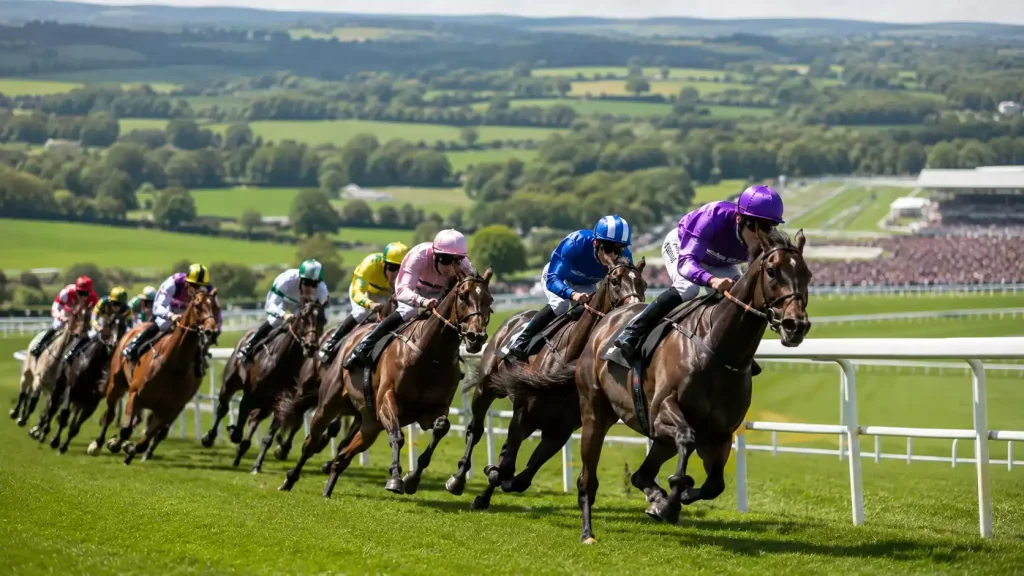
The Race the Track Helps Decide
Every Derby Day at Epsom I am asked the same question by friends: who is going to win? And every year I give the same useless answer: ask me after they have come around Tattenham Corner. The Derby is the only one of the British Classics where the racecourse itself is a meaningful third runner – a course that climbs, falls, cambers, sweeps, and finishes uphill in a way that catches out horses bred for clean galloping tracks. Three-year-olds get exactly one Derby. They cannot have a practice round. The horse that handles Epsom on the first day of June is not necessarily the best horse in the field, and after a decade of watching this race, I am still occasionally surprised by which horses can and cannot.
The Derby is the oldest of the five British Classics – the others being the 2,000 Guineas, the 1,000 Guineas, the Oaks, and the St Leger – and at a mile and a half, it is the middle-distance championship of the European three-year-old generation. It is run at Epsom Downs in early June, the day before the Oaks (though historically the running order was reversed). The race has been won by some of the great horses of the modern era – Galileo, Sea The Stars, Frankel never ran in it but everything else did – and it shapes the rest of the European Flat season for the winners and the also-rans alike.
Where the Derby sits in the calendar: Group races.
What the Derby Actually Is
The Derby is a Group One Classic for three-year-olds only, run over one mile, four furlongs and 6 yards. The race is restricted to colts and fillies, geldings are not eligible, and the maximum field is around 20 runners. The prize fund is one of the highest of any British Flat race, with the winner taking around £900,000 in recent renewals and total purse value north of £1.5 million.
The fillies’ equivalent is the Oaks, run the day before over the same distance. A small number of fillies have been entered for the Derby itself over the years – Fifinella won in 1916, Pawneese ran second, Cape Verdi finished ninth in 1998 – but it is rare. Most owners of top three-year-old fillies route them to the Oaks. The Derby is, in practice, a colts’ race.
The qualifying-form route to the Derby is well-established. The major trials are the Derby Trial Stakes at Lingfield in May, the Dante Stakes at York in May, and the Chester Vase. Winners of these trials usually appear in the Derby field at the head of the betting market. The 2,000 Guineas at Newmarket in early May produces some Derby horses – the colts who win the Guineas but who connections believe will stay further routinely run in the Derby – but Guineas-Derby doubles are rare in the modern era because the distances and the demands are increasingly specialised.
The total attendance at British racecourses in 2025 reached 5.1 million across 59 racecourses, with Epsom’s Derby Festival sitting among the higher-profile fixtures. Royal Ascot draws bigger daily crowds, Cheltenham draws bigger four-day cumulative numbers, but the Derby’s single Saturday remains one of the marquee dates of the Flat calendar.
The Track Itself
Epsom Downs is the most distinctive Classic track in Europe, and probably in the world. The mile-and-a-half Derby course begins on a sharp rise out of the stalls, climbs for the first four furlongs reaching the highest point of the course, then descends – slightly cambered to the inside – for the next four furlongs, around Tattenham Corner, into the home straight, where the camber switches and the run-in finishes uphill into the winning post.
Three features dominate how the race is run. First, the climb out of the stalls forces an early pace decision: a horse that fights for the lead up the rise is burning energy that will not be there in the final furlong. Second, Tattenham Corner – the long, descending, cambered bend into the home straight – requires both balance and willingness from a horse. A heavy-bodied colt that hangs on the bend can lose lengths it cannot recover, and a colt that takes the bend too wide can be overtaken on the inside even by a slightly inferior rival. Third, the uphill finish punishes any horse that has used too much petrol earlier in the trip.
The combination of climb, descent, camber, and uphill finish is unique among British tracks. Horses bred for galloping tracks like York, Newmarket, or Newbury can struggle to handle the gradient changes, even if they have the requisite stamina and class. Trainers know this. Most Derby fancied horses will have had at least one prep run on undulating ground – Goodwood, Epsom itself, or one of the trial races at Chester or Lingfield where camber and gradient feature.
One BHA executive captured the broader data demand of modern punting: “There is undoubtedly an ever-growing desire for data among those consuming and betting on racing. As other sports continue to develop ways in which their fans can gain greater insights through use of real-time data, this is an area racing must address.” For the Derby specifically, the data that matters most is gradient-specific form – and the readily-available racecards rarely highlight which horses have run on similar terrain. Doing your own legwork on previous-course form is where the edge lives.
Ante-Post on the Derby
The Derby ante-post market opens in the previous autumn – usually in October or November – for two-year-olds who have shown enough promise in the autumn juvenile races to be considered Classic prospects. Winners of races like the Royal Lodge Stakes at Newmarket, the Vertem Futurity Trophy at Doncaster, or the Champagne Stakes at Doncaster will typically be priced for the next year’s Derby within weeks of their juvenile success.
The ante-post market for the Derby is genuinely treacherous, and the reason is biology. Two-year-old colts develop physically through the winter at very different rates. A colt that looks like a Derby horse in October might develop into a sprinter by the following May, or might simply fail to train on at all. The horse you back at 10/1 in October might be a far longer price by April – or might no longer be entered.
The withdrawal rate from autumn-priced fancied Derby horses is higher than from autumn-priced fancied Cheltenham horses, in my experience. National Hunt horses target the Festival as a season culmination; Flat colts have multiple options as they develop, and the Derby is increasingly only one possible path rather than the obvious target. Some go to the Guineas and never come back to a mile and a half. Some go to the Eclipse or the Coral-Eclipse. Some go straight to Royal Ascot for the King George.
NRNB protection on Derby ante-post markets is offered by most major firms from roughly six weeks before the race. Ante-post betting on the Derby without NRNB is, in my view, only justifiable if you have very strong views about a horse and are prepared to lose the stake if it does not run. The general decision framework for ante-post is in the broader piece on ante-post betting and when the early price is worth the participation risk, and the Derby is where those principles bite hardest.
Stats and Trends
The historical patterns of the Derby reward careful reading more than the headlines suggest.
Favourites win the Derby roughly 30 % of the time over the long run – broadly in line with favourite-win rates in other Group One races, but with the wrinkle that the Derby favourite is often shorter-priced than the equivalent in a Royal Ascot Group One because the race attracts so much general-public money. A shorter favourite at the same probability is, by definition, worse value.
Trainer concentration is heavy. A small group of operations – Aidan O’Brien’s Ballydoyle, John Gosden, the Charlie Appleby / Godolphin operation – have dominated the Derby in the modern era. The first place I look on a Derby racecard is the trainer column. A horse from a yard with multiple Derby winners has demonstrated something a horse from a yard without one has not: namely, that the yard knows how to prepare three-year-olds to peak on the first Saturday in June over a mile and a half on Epsom’s terrain.
Jockey choices matter. The leading riders – Frankie Dettori prior to his retirement, Ryan Moore, William Buick, Oisin Murphy – have unique experience of riding Epsom’s gradient. A first-time Derby jockey on a fancied horse is not automatically a downgrade, but it is a data point worth weighing against the alternative.
Pedigree research is a serious business at this level. The breeding profile of a Derby horse – the sire’s record at the distance, the dam’s family’s records on undulating ground – is part of the form study that professional punters do and casual punters tend to skip. Sons of Galileo, in particular, have an outstanding Derby record stretching across multiple decades.
The class drop or rise should also be assessed honestly. A horse coming from a Group Two or Listed win straight into the Derby is being asked to take a meaningful step up in class. The trial races at Chester, Lingfield, and York are Group Three and Listed respectively – meaningful form, but not Derby-class form. Horses who have won at Group One or Group Two level before the Derby start from a different base than horses who have only won at lower levels.
The full picture is in our guide to UK horse racing betting basics.
Why is the Tattenham Corner section of the Epsom course so important to Derby form?
The descent into Tattenham Corner combines a cambered, sweeping bend with a gradient change that tests both physical balance and willingness in a three-year-old. Horses who hang on the bend, who fail to handle the camber, or who lose momentum through the descent typically cannot recover the ground on the uphill run-in. The corner sorts the field on a track-specific basis that does not feature on any other British Group One course.
Do horses who win the 2000 Guineas usually run in the Derby?
In the modern era, Guineas-Derby doubles have become increasingly rare. The Guineas is run over a mile and rewards a specific blend of speed and tactical pace, while the Derby is run over a mile and a half on undulating terrain. Many connections of Guineas winners now choose to keep their horses at the mile and target the St James"s Palace Stakes at Royal Ascot or the Sussex Stakes at Goodwood, rather than asking them to step up four furlongs in trip and handle Epsom"s gradient profile.
The wider picture of how Flat racing as a code differs from the jumps year – and how those differences shape the betting calendar around the Classics – is the subject of the broader piece on Flat racing versus National Hunt in British betting. The Derby is the most concentrated single illustration of why the Flat code rewards a different kind of analysis from the jumps, and reading the two codes side by side is, for my money, the single most useful exercise a beginning punter can do.