
Lucky 15, Lucky 31 and Lucky 63 Bets Explained
Best Horse Racing Betting Sites – Bet on Horse Racing in 2026
 Available in US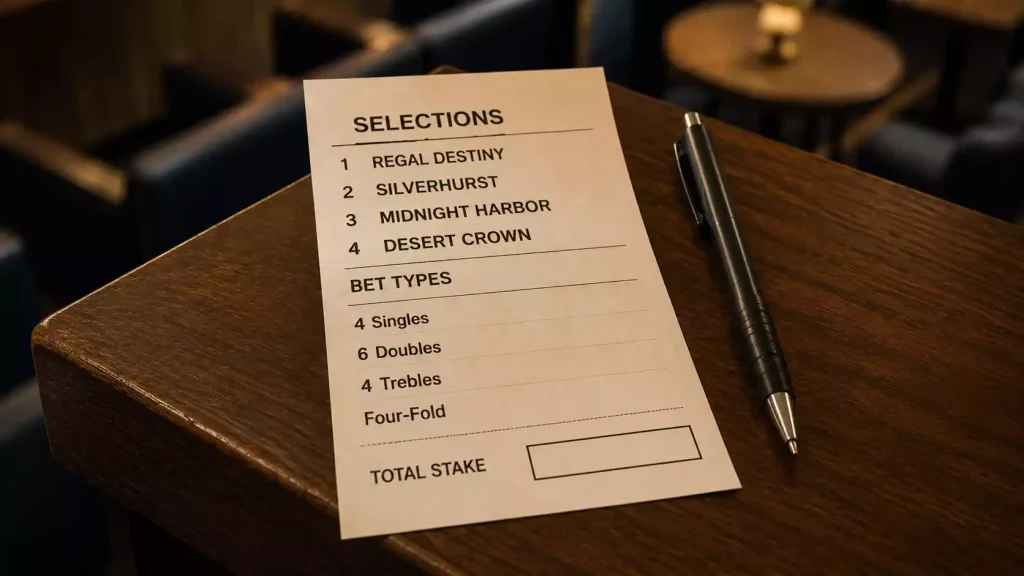
Fifteen Bets in One Slip
Walk into any UK betting shop on a Saturday morning and watch the windows. A surprising chunk of the slips going across the counter are not singles, not doubles, but Lucky 15s – four selections combined into fifteen lines of bets across one slip. The Lucky 15 is one of the most quietly entrenched bet structures in British betting culture, more popular than any racecard newcomer would guess from looking at the headline markets. Twenty-four-point-four million active betting accounts existed at the end of the most recent UKGC reporting quarter, and a meaningful share of those accounts will place at least one Lucky 15 a week during the racing season.
The bet appears generous on the slip – fifteen separate wagers from one selection of four horses, multiple ways to win something even if the slip is not perfect, bonuses promised for one winner or all winners. The maths behind that generosity is exactly what I want to walk through here, because the headline structure hides a bookmaker margin that compounds across every leg in a way most punters never bother to calculate.
The without-singles versions: Yankee, Patent and Heinz.
Lucky 15 Structure
A Lucky 15 is a full-cover bet on four selections, broken down into every possible combination of those selections excluding the empty bet. Specifically: four singles, six doubles, four trebles, and one four-fold. Add them up – 4 + 6 + 4 + 1 – and you have 15 lines, which is where the name comes from. Each line is staked at the same unit amount, so a £1 Lucky 15 costs £15 to place, a £2 Lucky 15 costs £30, and so on.
Let me walk through what each component does. The four singles each return their own win odds if that one horse wins. The six doubles each return the combined odds of any two of the four selections winning. The four trebles each return the combined odds of any three winning. The one four-fold returns the combined odds of all four winning.
The advantage of this structure over a straight four-fold accumulator is that you can still collect money even if not all four selections win. If only two of your selections win, the relevant double pays out – you would not collect at all on a four-fold accumulator under the same scenario. If three of your four win, you get the relevant treble plus three of the doubles plus the three singles. The Lucky 15 spreads your exposure across multiple outcomes, which is the structure’s genuine appeal.
The cost is that you are placing fifteen lines, each carrying the bookmaker’s overround. If the average overround on each race is around 12 %, the compounded overround across the four-fold is the product of those margins on each leg – and the singles, doubles, and trebles within the slip each have their own overround drag. The effective house edge on a Lucky 15 is significantly higher than the headline margin on any single race, because the same margin is being charged multiple times across the structure.
This is the mathematical heart of the bet, and it is the reason why Lucky 15s are heavily promoted by bookmakers despite looking “punter-friendly” on the surface. Every additional leg of compounding is another point where the house edge takes a bite.
Lucky 31 and Lucky 63
The Lucky 31 is the same structure applied to five selections, expanded to cover every possible combination. The maths: 5 singles + 10 doubles + 10 trebles + 5 four-folds + 1 five-fold = 31 lines. A £1 Lucky 31 costs £31. The shape is identical to the Lucky 15 – full cover, spread exposure, single-stake unit – but now scaled to five horses instead of four.
The Lucky 63 takes the structure to six selections: 6 singles + 15 doubles + 20 trebles + 15 four-folds + 6 five-folds + 1 six-fold = 63 lines. A £1 Lucky 63 costs £63. Beyond Lucky 63 the same principle could be extended further but bookmakers do not generally offer a “Lucky 127” on seven selections as a labelled bet – by that point the punter is firmly in the territory of named multi-selection multiples like Goliath, which have their own structures and bonus rules.
The trade-off as you scale up Luckys is unforgiving. The number of lines grows roughly with the power of two as you add selections, meaning the stake grows steeply. The probability of all selections winning falls as the product of their individual probabilities, meaning the big payouts get exponentially less likely. And the bookmaker’s overround applies to every line, so the effective margin compounds.
For practical purposes, the Lucky 15 is the structure that gets used most often on a typical racing card. Lucky 31s are usually placed on big festival days when punters can identify five horses they fancy across an afternoon. Lucky 63s are largely a once-a-year thing for many punters – Cheltenham Friday’s six races, Grand National day’s full card, the all-Festival cumulative slip. Outside those situations the stake is just too large for most everyday punters.
The full picture is in our guide to UK horse racing betting basics.
Bonuses Decoded
The bonus structure on Lucky bets is where the bookmaker’s marketing department earns its money – and where the punter most needs to read the small print.
The standard bonuses on a Lucky 15 are usually quoted as: “double odds on one winner” and “10 % bonus on all winners.” Let me unpack what these actually mean.
“Double odds on one winner” means that if exactly one of your four selections wins, the single bet on that winner is paid out at double its actual win odds. So if your only winner was at 4/1, the single line is settled as if it had been 8/1. The other 14 lines all lose. The bonus is a partial consolation for what would otherwise be a near-total loss on the slip – you placed £15 in stakes, you lost £11 in stakes (the 11 lines that did not contain your winner), and the £4 in stakes that did contain your winner is paid out at double odds. Helpful, but a long way from a winning slip.
“10 % bonus on all winners” means that if all four of your selections win, the total settled returns on the slip are increased by 10 %. So a Lucky 15 that returns £500 on the merits is paid out at £550. This bonus is rare in practice – four winners on the same slip is not an outcome that happens often – but it is a real headline number when it does.
The variation between bookmakers is significant. Some firms offer “treble odds on one winner” instead of double, which is mathematically generous. Some firms offer escalating bonuses – 10 % for all winners, but 5 % for three of four. Some firms apply the bonuses only to the singles portion of the slip rather than the overall return. The “best” Lucky 15 promotion is genuinely different at different firms, and the differences are visible in the effective payout on the same selections.
The key point: the bonuses do not make a Lucky 15 a value bet in isolation. They reduce the effective overround on the slip by a small margin, but they do not turn a negative expected-value bet into a positive one. They make Lucky 15s slightly less negative-EV than they would otherwise be – which is exactly the marketing function bookmakers want them to perform.
When the Structure Makes Sense
The Lucky 15 has a specific use case that is not “every Saturday afternoon.” It works best in particular situations and works poorly in others.
The structure makes sense when you have four selections you genuinely fancy, each at prices that give the bonuses something to bite on. Lucky 15s on four 1/2 favourites are mathematically dreadful – the doubles and trebles return so little that the bookmaker’s compounded margin dominates. Lucky 15s on four selections at 3/1, 4/1, 5/1, and 7/1 are a different proposition entirely, because the bonus structure can multiply meaningfully off prices in that range.
The structure makes sense for punters who want spread exposure rather than concentrated exposure. If you have £15 to bet on a Saturday and four horses you fancy, a Lucky 15 gives you fifteen different scenarios in which something can return rather than four single bets that either win or lose individually. The spread is real, and for some punters the experience of “having something running” through more of the afternoon is part of what they are paying for.
The structure does not make sense when you have a single horse you strongly fancy and three “fillers.” A four-selection slip is only as good as its weakest leg, and adding a coin-flip selection just to fill out the four-fold dilutes the value of the bet you actually believe in. Better to back the strong selection on its own and stop there.
Only 8 % of punters who bet on racing stake more than £100 a month, on the latest YouGov tracking, which puts the typical Lucky 15 stake squarely in the small-money entertainment bracket for most users. The bet is structurally designed to keep punters engaged across an afternoon for a modest outlay, and on those terms it does its job. The trouble starts when punters scale it up – Lucky 63s at £5 a line cost £315 a slip and demand four winners to break even at most price combinations.
Is the "double odds on one winner" bonus realistic on a Lucky 15?
The bonus only applies when exactly one of the four selections wins, which is a specific outcome rather than a common one. If your selections are at competitive prices – say, average odds around 4/1 – the probability that exactly one wins is roughly 35 to 40 % depending on independence assumptions. The bonus is realistic in the sense that it does fire reasonably often, but it does not turn a losing slip into a winning slip – it cushions what would otherwise be a near-total loss into a partial loss.
What is the difference between a Lucky 15 and a straight four-fold accumulator?
A four-fold accumulator is a single bet that requires all four selections to win for any payout. A Lucky 15 is fifteen separate bets that include the same four-fold as one line, plus all the smaller combinations and the four singles. The Lucky 15 returns money under more scenarios but at a higher total stake, while the straight four-fold has a much lower stake for the same selections but pays out only if everything wins. The choice depends on whether you want concentrated exposure to all-four winning or spread exposure across multiple partial outcomes.
The Lucky 15 is one structure within a broader family of “full-cover” multiples that includes some without singles and some scaled to larger numbers of selections. The closely-related Yankee, Patent, and the bigger Heinz and Goliath family deserve their own treatment, which I have given in the practical guide to the Yankee, Patent, Heinz and Goliath multiple structures.
Articles
Created by the "" editorial team.