
In-Play Betting on Horse Racing
Best Horse Racing Betting Sites – Bet on Horse Racing in 2026
 Available in US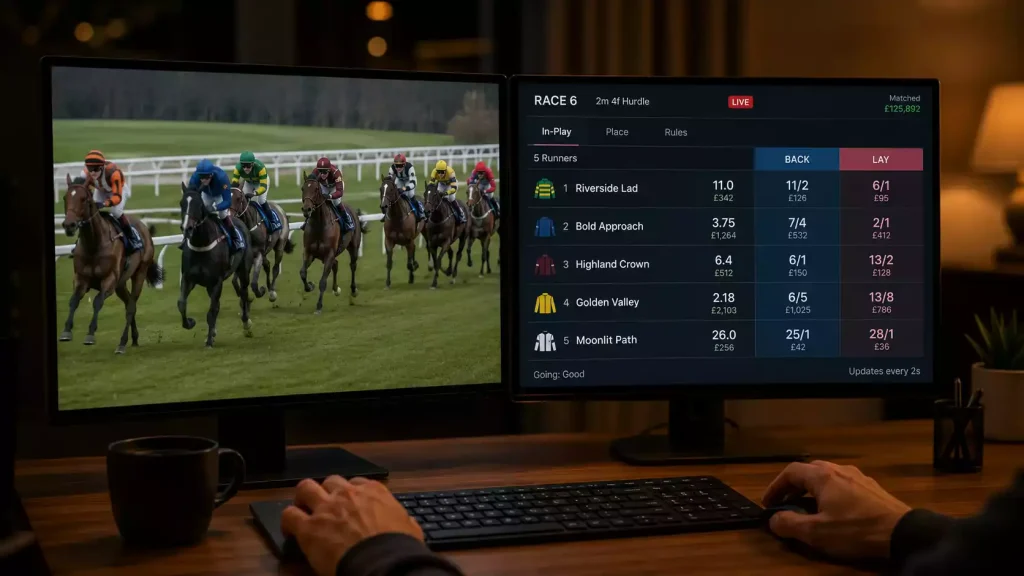
In-play betting on horse racing is unlike in-play betting on almost any other sport. A football match lasts ninety minutes. A tennis set can run an hour. A horse race lasts three to ten minutes, sometimes less, and every betting decision in that window is made under real-time price movement, broadcast delay and physical race developments that nobody in the market can predict more than a second or two ahead. Once you’ve experienced the rhythm of in-running on a four-mile chase, you understand why this is the part of the market where amateurs lose money fastest and where the most disciplined professionals find their best opportunities.
The mechanics of in-play have been transformed since betting exchanges arrived. What was once a quiet sideline of pre-race punting has become a serious, high-volume market – the Betfair pre-off win market on Boxing Day in 2024 turned over £11.2m, down from £13m in 2023 – and the in-running activity that follows is now where much of the day’s most active price discovery happens. Whether you intend to use it actively or not, understanding how the in-play market behaves is part of understanding modern UK racing punting.
The market that runs it: betting exchanges.
How In-Play Actually Works
The in-play market opens the moment the race goes off, when the pre-off market closes and a new “in-running” market becomes available. Prices on every runner are now live, updating continuously, and shaped by the unfolding race – who is leading, who is travelling well, who is being asked questions, who is dropping out of contention.
Two structural realities define this market. The first is speed. Prices on a betting exchange can move from 5.0 to 2.0 in two seconds when a horse takes the lead at the head of the straight. By the time you’ve processed what you’ve seen, the price you saw has moved. The lag between observation and execution is the single biggest obstacle for retail in-play punters.
The second is liquidity. The major UK racing markets – Cheltenham races, the Grand National, Royal Ascot features – have deep in-play liquidity, meaning bets of significant size can be placed without moving the price materially. Smaller midweek races have thin in-play markets, which means the spread between back and lay prices is wider and the cost of trading higher. A profitable in-play strategy at Cheltenham may produce loss after costs at Pontefract simply because of liquidity differences.
The in-play market segments into bookmaker products and exchange products. Bookmakers offer in-play prices on their own books, usually with tighter limits and slower updates than exchanges. Exchanges – Betfair principally, but also Smarkets – offer peer-to-peer markets where the prices move continuously based on user activity. The exchange tends to be the reference point that bookmakers track, with a small delay.
The volume of remote betting in the UK overall reached £7.8bn in gross gambling yield for April 2024 to March 2025, and a meaningful slice of that is in-play activity. The in-play market is no longer a niche; it is a major part of how UK punters interact with racing.
Picture Delay and the Latency Problem
Here’s the question every new in-play punter eventually asks: why does the price seem to move before I see the action that should have caused it? The answer is picture delay, and it is the most consequential structural feature of the in-play market.
The pictures you watch on television or via streaming services are not real-time. They run through a broadcast chain – camera, encode, satellite or fibre, decode, display – that introduces several seconds of latency between the live event and what reaches your screen. The exact number varies: a TV broadcast might be five to seven seconds behind the live event, a streamed feed can be twelve to fifteen seconds behind, and on a mobile connection in poor signal, it can be even more.
The market, meanwhile, is reacting to the actual event. Punters watching on the racecourse, plus the small number of operators with access to direct feeds, are pricing in real time. Their information reaches the exchange seconds before your television picture does. The result is that prices move “ahead” of what you see – and if you bet based on what your screen shows, you are systematically taking the wrong side of a price that has already adjusted.
The implication is unforgiving. Retail punters acting on screen pictures are usually getting the worst available price by the time their bet is matched. Brant Dunshea, the BHA chief executive, has pointed at this issue from a sport-development angle: “There is undoubtedly an ever-growing desire for data among those consuming and betting on racing. As other sports continue to develop ways in which their fans can gain greater insights through use of real-time data, this is an area racing must address.” The data and timing asymmetries he refers to are exactly what punish casual in-play punters every time they bet on what they’ve seen rather than what the market has priced.
There are partial mitigations. Some operators offer faster feeds. Some traders make a living from the latency arbitrage between different feeds. But the fundamental position for the recreational punter is unchanged – you are always behind, and the strategies that work in-play either accept this or find ways to bet on signals that don’t depend on observing live action.
The full picture is in our guide to UK horse racing betting basics.
Suspended Markets and Cash Out
When the field reaches the final furlong, or when a horse takes a clear lead, the in-play market is often suspended briefly. Suspensions are deliberate – they prevent late bets being matched on stale prices and protect both the operator and the wider market from execution errors. The suspension typically lasts a few seconds, during which no bets can be placed, then the market reopens with prices reflecting the current state of the race.
Suspensions are not always at obvious moments. A market may suspend when a horse looks like falling, when a stewards’ enquiry seems likely, or when liquidity has briefly dried up. For the punter, the suspension means that a bet you intended to place can simply fail to be matched, leaving you wishing you had acted earlier – or, sometimes, relieved that you didn’t.
Cash out is the related concept on bookmaker products. A cash-out option lets you take a guaranteed return on a winning or partially winning bet before the race ends, in exchange for closing the position at the operator’s offered price. The cash-out price always includes a margin against the true expected value, sometimes a significant one. Bookmakers offer cash out because it locks in punter equity at margins favourable to the book; punters use cash out for the psychological certainty of a known return.
Whether cash out is a good idea depends entirely on price. A cash-out offer of £80 on a bet that should mathematically be worth £100 is a 20% cost – paid for psychological comfort. For most disciplined punters, cash out is a tool to be used sparingly and only when the offered price approximates the true expected value, which is rarely the case.
The cash-out interface is most useful as an emotional safety valve rather than a profit-maximising tool. Used in that spirit – locking in a position you’d regret losing rather than chasing maximum value – it can be a reasonable part of an in-play strategy. Used as the default exit from every position, it is a slow leak in your bankroll.
In-Play on the Exchange
Betting exchanges are the natural environment for in-play activity. The peer-to-peer structure means prices reflect actual demand and supply rather than a bookmaker’s risk-management model, and the speed of price updates is faster than on bookmaker products. The Betfair in-play market for major UK races sees genuine, deep liquidity from professional traders and serious recreational users.
The strategies that work on the exchange in-play tend to fall into a few categories. Backing horses you think will trade shorter – taking a price now in the expectation of the market valuing the horse higher later in the race – is the most intuitive approach. Laying horses at short prices and hoping to back them at longer prices later is the trading mirror image. Arbitrage between bookmaker and exchange prices on the same runner exists when the bookmaker is slow to react to market moves, although the windows are small and shrinking.
The technical demands of serious in-play trading are real. Professional traders use dedicated software, direct feeds, multiple monitors and sub-second execution. The retail punter using a smartphone over a domestic broadband connection is at a structural disadvantage in every dimension. Recognising that disadvantage is the start of building an in-play approach that survives it – usually by betting on conditions that don’t require fast execution.
The interaction with pre-race exchange prices matters too. The pre-off market closes when the race begins, and the prices it left behind influence in-running expectations. A horse trading well below its morning price going into the off is often heavily backed in-play if it makes a positive early move, because the market memory carries through. For the full picture of how exchange mechanics work either side of the off, see our guide to back and lay on betting exchanges.
FAQ
Why does the in-play market suspend at apparently random moments?
Suspensions happen for several reasons: an obvious change in the race state (a leader establishing daylight, a faller, a stewards" query), thin liquidity that creates execution risk, or operator concerns about late bets being matched on stale prices. The suspension is brief – usually a few seconds – and the market resumes once the operator is confident the prices reflect current conditions.
Should I bet in-play if my screen is delayed by 10 seconds or more?
Generally, no – at least not on signals derived from what you see on screen. The market has moved before your picture catches up, and you are systematically getting prices that have already adjusted. If you do bet in-play with a delayed feed, focus on slower decisions – pre-determined exit prices, value triggers – rather than reactive bets on live action.
Is cash out always available on horse racing bets?
No. Cash out availability depends on the operator and the bet type. Single bets on major races usually have cash out throughout the in-running phase; multiples, complex bet types and races at smaller meetings may not. The cash-out price is also continuously calculated and may be suspended at the same moments the main market suspends.
The Honest Position on In-Play
In-play horse racing betting is the most demanding form of UK punting and the most likely to produce sharp losses for the casual user. The structural disadvantages – picture delay, execution speed, professional liquidity – are real and don’t disappear with experience. The punters who use in-play well treat it as a specific tool with specific applications, not as an extension of their pre-race punting. The honest position is that for most recreational punters, the time and effort invested in becoming competent at in-play is better spent on tightening pre-race analysis and price comparison. The in-play market will still be there when you want to engage with it, and the punters who succeed in it are the ones who arrive with their pre-race work already done.
Articles
Created by the "" editorial team.