
Yankee, Patent, Heinz and Goliath Multiples
Best Horse Racing Betting Sites – Bet on Horse Racing in 2026
 Available in US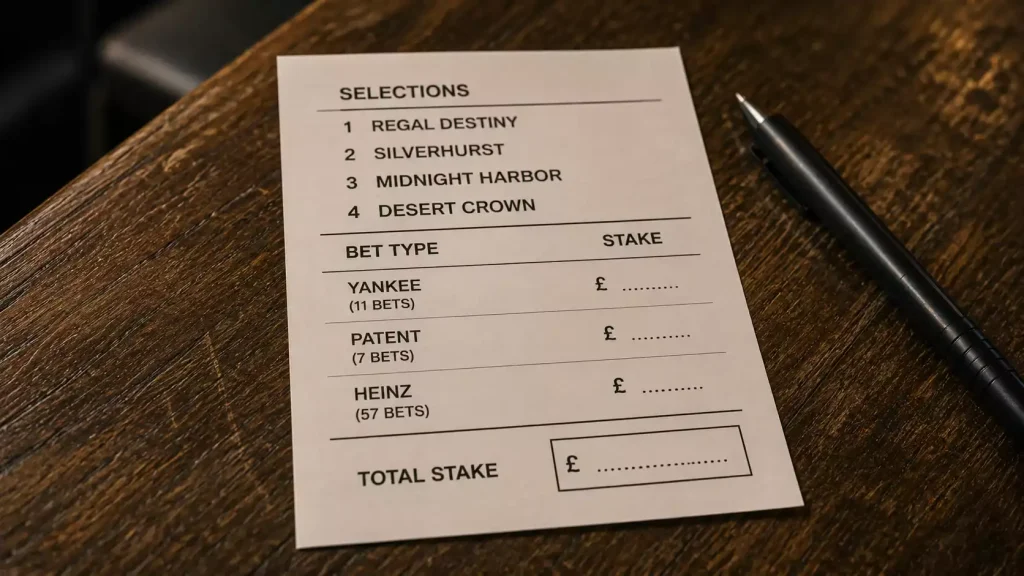
Two Families, One Slip Each
An old hand at the racing once told me there are exactly two kinds of multiple bets in British betting: the ones with singles, and the ones without. He poured a beer, said it like it was profound, and then took twenty minutes to walk me through why it mattered. Fifteen years later, I think he was right. The Yankee-Patent-Heinz-Goliath family of multiples splits cleanly along that axis. Lucky 15s, Patents, and similar “with singles” structures keep you in the game even if only one horse wins. Yankees, Heinzes, and Goliaths – the “without singles” structures – give you no consolation for one winner. The same number of selections, the same bookmakers, very different shapes of outcome. The 2024-25 remote betting GGY of £766.7 million on UK horse racing rests in significant part on punters who do not understand which family they are committing to.
The “with singles” family – Patent, Lucky 15, Lucky 31, Lucky 63 – costs more for the same number of selections because of the extra single lines. The “without singles” family – Trixie, Yankee, Heinz, Super Heinz, Goliath – costs less but demands at least two winners on the same slip before any return is generated. Choosing between them is not a matter of preference. It is a matter of how much you believe in your weakest selection.
The with-singles versions: Lucky 15, 31 and 63.
Yankee Compared to Lucky 15
A Yankee is a full-cover multiple on four selections, but without singles. The structure: 6 doubles + 4 trebles + 1 four-fold = 11 lines. A £1 Yankee costs £11. Compare that to a Lucky 15 on the same four selections, which costs £15 because it adds the four singles. The pricing difference is £4 per unit stake – about 27 % less for a Yankee.
What you give up for that saving is the consolation prize. If only one of your four selections wins on a Lucky 15, the single bet on that horse returns, possibly with a “double odds on one winner” bonus on top. If only one of your four selections wins on a Yankee, you get nothing – every line on the slip required at least two of your selections to win. The Yankee is essentially the Lucky 15 minus the safety net.
When does the trade-off favour each structure? The Yankee favours punters who genuinely fancy multiple winners. If you believe two or more of your four selections will win, the Yankee gives you better effective odds per pound staked because you are not paying for the singles you will never collect on. The Lucky 15 favours punters who want exposure even if their main idea is one or two horses they really fancy.
My rule of thumb: if you would not bet at least two of the four selections individually as standalone bets, the Yankee is the wrong structure. Without the conviction that at least two horses will win, you are paying for combination lines that have a low probability of returning anything at all. The Lucky 15 is the safer choice in those situations, with the caveat I have walked through in the dedicated piece on the Lucky 15 structure and how its bonuses actually work.
Patent on Three Selections
The Patent is the “with singles” structure on three selections, the smaller cousin of the Lucky 15. Structure: 3 singles + 3 doubles + 1 treble = 7 lines. A £1 Patent costs £7.
The Patent’s “without singles” counterpart is the Trixie, which contains 3 doubles + 1 treble = 4 lines. A £1 Trixie costs £4.
The Patent is the structure I see most often used by punters who want to back three horses across an afternoon at a midweek meeting, with enough small-bet exposure to keep things interesting without committing to a Lucky 15’s larger stake. The maths is friendlier than people sometimes realise: with three selections at, say, 4/1 each, a £1 Patent returns:
If all three win, the slip returns the treble (5 × 5 × 5 = 125, so £125 in winnings) plus the three doubles (5 × 5 = 25 each, so £75 total) plus the three singles (5 each, so £15). Total return on a £7 stake: £215. Net profit £208.
If two of the three win, the slip returns one double (25, so £25) plus the two relevant singles (10) for a total of £35. Net profit £28 on £7 staked.
If one of the three wins, the slip returns just that single – £5 on a £7 stake. Net loss £2.
If none wins, you lose the full £7.
The Patent’s structure is genuinely sensible for three-selection betting because it scales the bet’s exposure to the conviction level on each leg. The Trixie, by contrast, returns nothing on one winner – you need two of three for any return at all. Most casual punters who think they want a Trixie actually want a Patent and just have not done the maths.
The full picture is in our guide to UK horse racing betting basics.
Heinz, Super Heinz and Goliath
The “without singles” family scales up beyond the Yankee with progressively larger structures: Heinz on six selections, Super Heinz on seven, Goliath on eight.
The Heinz: 15 doubles + 20 trebles + 15 four-folds + 6 five-folds + 1 six-fold = 57 lines. A £1 Heinz costs £57. The name comes from the “57 varieties” of the famous condiment company. The structure requires at least two winners from six selections to generate any return at all, and the payout scaling depends entirely on how many of the six win and at what prices.
The Super Heinz: 21 doubles + 35 trebles + 35 four-folds + 21 five-folds + 7 six-folds + 1 seven-fold = 120 lines. A £1 Super Heinz costs £120. Seven selections, no singles, full cover.
The Goliath: 28 doubles + 56 trebles + 70 four-folds + 56 five-folds + 28 six-folds + 8 seven-folds + 1 eight-fold = 247 lines. A £1 Goliath costs £247. Eight selections, no singles, full cover. The name is appropriate.
One BGC executive recently commented on the broader pressures on the regulated betting industry: “This exemption is cosmetic. Beneath the surface, this Budget delivers a devastating blow to the very ecosystem that racing relies on.” The broader point applies to how multiples are constructed and marketed too – when the regulated industry is under pressure, the heavily-promoted multiple structures tend to be the ones with the best margins for the bookmaker, not necessarily the ones with the best value for the punter. Heinzes and Goliaths sit toward the high-margin end of that scale.
These structures have a real use case in two specific contexts. First, the once-a-year occasions where a punter has serious conviction on multiple selections across a major card – Cheltenham Friday, Grand National day, a packed Royal Ascot afternoon. The volume of selections justifies a full-cover structure that includes them all. Second, the small-stake “one winner of six” approach where the punter pitches in a low unit stake on six longshots, hoping a couple come in at big prices and the doubles return meaningfully. Most other contexts, the maths is hostile.
Picking the Right Structure
The decision tree I run on a Saturday morning when I am thinking about a multiple looks like this.
How many selections do I genuinely fancy? Not “have an opinion on,” but “would back as a single bet if pressed.” If the answer is one, a multiple is the wrong structure – back the single. If the answer is two, a double or a Trixie if you can find a third reasonable selection to round out the maths. Three good selections suggest a Patent or a Trixie. Four good selections suggest a Lucky 15 or a Yankee. Five suggest a Lucky 31. Six suggest a Lucky 63 or a Heinz. Anything beyond six is either festival territory or the structure is taking over from the selections, which is a sign to step back.
How much exposure do I want to “one winner” outcomes? “With singles” structures pay out the single line if only one selection wins, which keeps the slip alive emotionally even when the day has not gone to plan. “Without singles” structures require at least two winners for any return. If you would be genuinely upset to end the afternoon with one winner and nothing to collect, you want a “with singles” structure regardless of the slightly higher cost.
What is the average odds of my selections? At short prices – average 5/2 and below – the multiple structures struggle to generate meaningful returns even with multiple winners, because the doubles and trebles compound to disappointing totals. At medium prices – average 4/1 to 8/1 – the multiples really start to earn, with the trebles and four-folds producing the headline returns when they hit. At long prices, the maths is theoretically attractive but the probability of multiple winners falls sharply.
Twenty-four-point-four million active accounts at the UKGC’s most recent count, holding a total of around £1 billion in customer funds, includes a significant share of punters who place multiples without doing this calculation. The structure-selection question is not a side issue. It is, for serious multiple bettors, the single most important pre-bet decision. The selections matter less than people think; the structure matters more.
What is the main difference between a Yankee and a Lucky 15?
A Yankee is a Lucky 15 minus the four singles. Both cover the same four selections with the same six doubles, four trebles, and one four-fold, but the Yankee has 11 lines while the Lucky 15 has 15. The Yankee costs less per unit stake but requires at least two winners for any return, while the Lucky 15 will return the single line even on one winner.
Are Heinz and Goliath bets worth placing for casual punters?
As a general rule, no. The required stakes scale steeply – £57 minimum for a £1 Heinz, £247 minimum for a £1 Goliath – and the structures only generate meaningful returns when multiple selections win at reasonable prices. For most casual punters the maths is hostile in expected-value terms. Heinz and Goliath bets earn their keep on specific festival cards where the punter has strong conviction on multiple selections, not as a general Saturday afternoon structure.
The Lucky 15, Yankee, and Patent family are only one corner of the wider universe of bet types available to British punters. The broader landscape – singles, accumulators, forecasts, tricasts, pool bets, exchanges, ante-post – is the subject of the practical overview of the main bet types British punters use, and reading that in conjunction with this piece will give you a clearer sense of where multiples sit in the wider menu.