
Going and Ground Conditions in UK Horse Racing Explained
Best Horse Racing Betting Sites – Bet on Horse Racing in 2026
 Available in US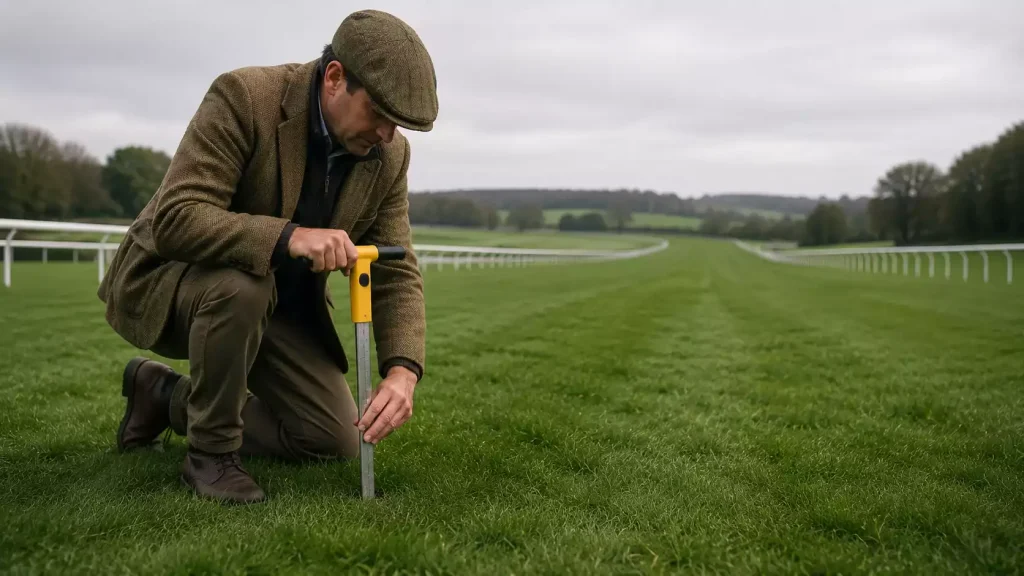
The word “going” looks deceptively simple on a racecard, but it’s not a mood or a descriptor – it’s a measurable property of the racing surface, and it changes how fast horses can travel, how long they can sustain that pace, and how likely they are to lose their footing. After a decade reading form, I’ve come to treat the going line as the single most undervalued field on the entire card. Punters obsess over weights and trainer form, then ignore that the same horse will run six lengths better or worse depending on whether the ground reads “Good” or “Soft, Heavy in places”.
The British turf produces a wider spectrum of surfaces than almost any racing nation on earth, partly because we race year-round and partly because our weather refuses to commit to anything. A horse who breezed home at Goodwood in July might struggle to find a gallop at Haydock in November on the same nominal distance. Understanding what each going description actually means – and how to translate that into a betting decision – separates pin-sticking from analytical punting. Crowds keep coming back to watch it: Q1 2026 alone drew 696,611 attendees across 292 fixtures, a 4.6% rise year-on-year, and many of those punters live or die by their reading of the turf.
Where the going sits on the card: reading a racecard.
The Going Scale from Heavy to Firm
I once stood next to a clerk of the course at Sandown on a grey October Saturday and watched him push the GoingStick into the home straight three times in a row, frowning. “It’s Soft,” he said, “but it’ll be Heavy by the bumper.” That’s the going scale in a sentence – it’s a moving target, and the labels are negotiated between physics, weather and judgement.
The British scale runs through seven principal descriptions, and you’ll see them in roughly this order from wettest to driest:
Heavy is the bottom of the scale on turf. Water sits at the surface, divots come up like sponge, and times stretch dramatically. Stamina becomes the dominant factor; a horse who wins on Heavy is almost always a galloper with a deep aerobic engine. Falls and pulled-up finishes rise sharply, particularly over jumps.
Soft is the going that defines a National Hunt winter. The surface yields under the hoof but doesn’t suck at it. Bigger, rangier types thrive; light-actioned milers tend to struggle. Many top jumpers have their entire profile built around soft ground because that’s when their relative stamina advantage matters most.
Good to Soft is the British compromise – slightly tacky, holding moisture but still giving a fair gallop. It’s the most common winter description and the one that produces the widest spread of winners, because both ground-loving and versatile horses can act on it.
Good is the textbook ideal: enough cushion to protect joints, enough firmness to allow speed. The vast majority of stakes races in the UK are won on Good or close to it. If a horse “has no excuses” in trainer-speak, the ground is usually Good.
Good to Firm tips towards quicker ground. Class horses who travel well into a race tend to dominate; slower, ground-needing types are exposed. Sprint times come down noticeably here.
Firm is now rare in Britain – clerks water aggressively to avoid it because of welfare concerns about jarring up. When it does appear, expect quick times and a premium on tactical speed.
Standard is reserved for all-weather surfaces, which I’ll come to later. Watered or not, polymer-based tracks don’t move through the turf scale.
Modifiers matter too. “Good to Soft, Soft in places” tells you the bend or back straight is wetter than the home turn, which has real implications for where a jockey wants to be positioned. Treat the modifier as data, not decoration.
How the Going Is Actually Measured
Most punters assume the going description is one person’s opinion. That used to be true. Today it’s a hybrid of mechanical reading and human judgement, and the mechanical part is the GoingStick.
The GoingStick is a tubular probe pushed into the turf to a fixed depth, then levered sideways. Sensors record two values: penetration force (how much pressure it takes to push down) and shear force (how much resistance the turf gives when pushed forward). The instrument outputs a single number, typically between 5.0 and 12.0 on British courses. Below 6.0 is properly Heavy. Around 6.5-7.5 is Soft. The 8.0-9.0 band tends to describe Good to Soft and Good. Above 10.0 you’re into Firm territory.
The clerk takes readings at multiple points around the course – usually at every furlong marker, sometimes more densely on the home straight where the field is bunched. Those values are averaged and cross-checked against a manual walk of the track. The clerk pushes a heel in, watches how the divot rebounds, looks at how the grass cover sits, and adjusts the published description if the GoingStick number doesn’t match what the surface is telling them by hand.
That judgement step matters. A reading of 7.2 might be called “Soft” at one course and “Good to Soft” at another, depending on root structure, drainage profile and the clerk’s read on how the ground will change during the meeting. The BHA’s Director of Racing, Richard Wayman, framed the wider challenge plainly during last year’s debate about declining wagering: “Whilst there is work to be done on the racing product to grow its appeal as a betting medium, there would be a much wider range of factors contributing to this concerning decline.” Going inconsistency between courses is one of those factors – punters who get burned by a “Good” that rode like Soft tend not to forget it.
The full picture is in our guide to UK horse racing betting basics.
How Going Reshapes Form
Here’s the test I run on every racecard before placing a single bet: I take each horse’s last three completed runs, note the going at each, and ask whether today’s surface lies inside their proven range. If a horse has only ever won on Good or quicker and the clerk has just announced Soft after overnight rain, I downgrade that horse aggressively – sometimes to “no bet” status, regardless of price.
The mechanics are simple. A horse’s stride pattern is biomechanically tuned to how much the ground gives. On softer surfaces, the hoof sinks, the leg has to work harder to push off, and the heart rate climbs faster for the same speed. Horses with a low, daisy-cutting action – sprinter types in particular – lose proportionally more energy per stride on Soft than horses with a higher, rounder action who lift their knees clear of the surface naturally.
Look at the going line in a runner’s form figures, not just the finishing position. “2” on Heavy at Wetherby in February tells you far more than “1” on Good at Bath in July, because the Heavy run filtered out half the field before they reached the turn for home. A horse who finishes within a length or two on demanding ground has demonstrated a stamina credential the form figure alone won’t reveal.
Pace shape changes too. Soft ground tends to produce a slower early gallop, which favours horses who can quicken from off the pace. Firm ground encourages a stronger early tempo, which suits front-runners and those with cruising speed. If you’re reading a card and the going has changed since declarations, you should be re-reading every pace map at the same time. For a deeper walkthrough of how going slots into the rest of the racecard, see our guide to decoding a UK racecard.
The market is sometimes slow to react when going changes overnight. That’s where the edge sits – if you’ve done the homework and the prices haven’t caught up, you’ve got a window of perhaps an hour after the going update to act before the smart money corrects it.
All-Weather Surfaces and Their Quirks
All-weather racing in Britain sits on synthetic surfaces, principally Polytrack and Tapeta, with a smaller proportion of Fibresand at certain tracks. These materials behave nothing like turf, and they require a different reading framework.
Polytrack is a mix of silica sand, polymers, recycled rubber and synthetic fibres, coated in wax. It drains within minutes and stays consistent across seasons. Lingfield, Kempton and Chelmsford use it. The going on Polytrack is almost always described as Standard, occasionally “Standard to Slow” if the track has been recently rolled or watered. Times are predictable, draw biases are well-mapped, and form translates cleanly meeting-to-meeting.
Tapeta, used at Newcastle and Wolverhampton, contains similar components but with a finer fibre mix and a different wax coating. It rides slightly deeper than Polytrack in my experience, and it tends to reward stronger, more powerful types over pure speed merchants.
The crucial distinction for punters is that all-weather form rarely transfers directly to turf, and vice versa. A horse who has won three times on Polytrack is not necessarily a “going horse” in the turf sense – they’re a surface specialist, and putting them on Good ground at Newbury can produce a flat, lifeless performance. I treat all-weather and turf as two parallel codes for form-reading purposes, with cross-references only where a horse has explicitly proven competent on both.
The volume of all-weather fixtures is one reason British attendance figures have held up so well – the first half of 2025 saw 5.1% year-on-year growth in racecourse attendance, with all-weather meetings filling weekday slots that turf simply can’t cover in winter. That consistency makes the all-weather book more efficient than turf in many cases, which means edges are harder to find but easier to back with confidence when you do spot them.
FAQ
What"s the difference between Good to Soft and Soft, Good to Soft in places?
The first describes the average condition of the whole track. The second tells you there are localised wetter patches – typically on the inside or in the back straight – within an otherwise Soft surface. The second description matters because it changes where a jockey wants to position the horse during the race.
Is the GoingStick reading always reliable?
It"s the most objective tool available, but it"s a snapshot. Conditions can change in hours through rain, wind or watering. The published going is the clerk"s best summary at the time of writing, and on changeable days you should treat the morning reading as provisional and check for updates closer to the off.
Why don"t UK courses use a numerical going scale like France?
France publishes the going as a single number from 1 to 5, but British racing has retained descriptive labels because clerks argue they convey nuance – for instance, the difference between watered Soft and rain-fallen Soft, which ride differently despite the same GoingStick reading. Both approaches have advocates, and the BHA reviews the system periodically.
Treating the Going Line as a Live Variable
The going description is not a label printed once and forgotten. It moves through the day, sometimes through the card, occasionally between races. The punters who win consistently are the ones who treat the going as a live input – checking the morning update, then the lunchtime revision, then the on-course assessment after the first race, and reweighting their selections each time. The form figure tells you what a horse has done; the going tells you whether it can do it again today. Get those two readings aligned, and most of the rest of the racecard starts to make sense in a way it never did when “Soft” was just a word at the top of the page.