
Major UK Racecourses: A Tracks Overview
Best Horse Racing Betting Sites – Bet on Horse Racing in 2026
 Available in US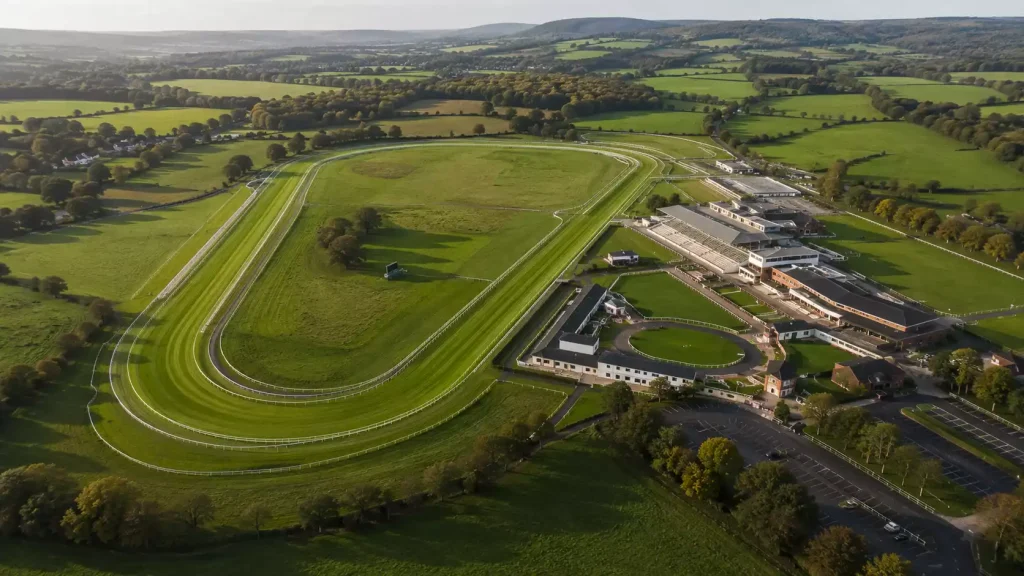
Britain has 59 racecourses, split between Flat, National Hunt and mixed-track operations, and the variety across that small island is one of the underappreciated features of British racing. Each course has a shape, a surface, a set of cambers, an undulation pattern and a wind exposure that shapes which horses win there and which simply don’t. This is the most freely available information in the entire sport – every form line tells you which course produced each run – and recreational punters systematically underuse it. The track is half the race, and reading the track is one of the most reliable edges available to anyone willing to learn the differences.
The footprint matters economically too. British racing supports 20,000+ direct jobs across 59 racecourses, 500+ training yards and 660 breeding operations, and the first half of 2025 saw 704 fixtures hosting more than 2.4 million attendees. These tracks are not interchangeable venues; they are the physical infrastructure on which the sport’s economy rests, and each one shapes the racing it produces in ways the cards don’t always make obvious.
Why the shape of a track matters: draw bias.
The Major Flat Tracks
Newmarket is the headquarters of Flat racing in Britain – two separate tracks, the Rowley Mile and the July Course, both broad galloping circuits designed for big fields and clean racing. The Rowley Mile hosts the 2,000 Guineas and 1,000 Guineas in early May; the July Course hosts the July Cup in mid-summer. Horses who win at Newmarket tend to be galloping types with stamina enough to come from off the pace – the long straight gives a real test of finishing speed.
Ascot is the most famous track in British racing, partly because of Royal Ascot in June and partly because of the King George VI and Queen Elizabeth Stakes in July. It’s a right-handed track with significant undulation and a long uphill finish that punishes horses whose stamina hasn’t been fully tested. Royal Ascot draws an average of 54,984 spectators per day across its five days – the heaviest concentrated week of attendance in the British calendar.
York is a flat, level, galloping left-handed track that produces some of the fairest racing in Britain. The Ebor meeting in August features the Juddmonte International, the International Stakes and the Yorkshire Oaks. York is a course where the best horse usually wins, because the track itself doesn’t impose tactical complications – a quality reading is well-rewarded here.
Epsom is the opposite of York – a tight, undulating, left-handed track with a steep descent into Tattenham Corner and a cambered straight that has been the undoing of many talented horses unsuited to the conformation. The Derby in early June is the headline race, and the form Epsom produces tends to be specific to that course’s demands. Horses who handle Epsom often run well on similarly undulating tracks; horses who can’t get round Epsom may run respectably at York and never threaten at the Derby venue.
Newbury, Goodwood, Doncaster, Sandown and Haydock fill out the upper tier of British Flat racing, each with its own configuration and characteristic winners. Newbury is straightforward galloping ground; Goodwood is a switchback of cambers and bends that has its own form pattern; Doncaster is the home of the St Leger.
The Major National Hunt Tracks
Cheltenham is the spiritual home of jumps racing, and the Cheltenham Festival in March is the championship event of the National Hunt calendar. The course is a left-handed undulating circuit with a stiff uphill finish that demands stamina and resolution. Almost every Festival race rewards horses who travel comfortably to the last and have something left for the climb home. Cheltenham draws an average of 60,583 spectators per Festival day – the highest concentrated attendance of any meeting in British racing.
Aintree, host of the Grand National in April, is a unique left-handed circuit famous for the Grand National fences – including Becher’s Brook, the Chair and Foinavon – which are taller, broader and trickier than standard fences elsewhere. The Mildmay course at Aintree hosts the Grand National meeting’s secondary races over conventional fences, and the configuration as a whole produces specialist Aintree form that doesn’t always translate cleanly to other tracks.
Sandown is a right-handed undulating track with the Pond Fence – the third-last fence in chase races, situated unusually close to the second-last – that has caught out countless top-class horses. Sandown’s chase course is one of the genuinely tactical configurations in British jumps racing, and the form it produces is highly regarded.
Kempton on Boxing Day hosts the King George VI Chase, the mid-season championship race over three miles. The right-handed flat course suits horses with cruising speed and good jumping technique – Kempton is fairly tight by British standards, and a horse who can travel cleanly around its bends and meet its fences right is well-served by the track.
Other significant jumps tracks include Newbury, Ascot (which hosts both Flat and jumps fixtures), Haydock, Wetherby and Doncaster. Each produces its own characteristic winner-profile, and reading the jumps form book without reference to the track is reading half the picture.
The full picture is in our guide to UK horse racing betting basics.
Mixed Tracks and Regional Variety
Many British courses host both Flat and National Hunt fixtures, switching between codes through the year. Doncaster, Newbury, Haydock, Ayr and Musselburgh are among the prominent mixed tracks, and the shared infrastructure means that punters who follow one code at these courses are usually familiar with the other too.
The all-weather tracks – Lingfield, Kempton, Newcastle, Wolverhampton, Chelmsford, Southwell – provide the winter Flat racing programme on synthetic surfaces. These tracks have their own form patterns, often producing more efficient and predictable racing than the turf alternatives because the surface is stable and the weather doesn’t intrude. Lingfield and Kempton use Polytrack; Newcastle and Wolverhampton use Tapeta; Southwell has been the principal Fibresand course.
Regional variety matters more than visitors to British racing sometimes realise. Northern racing – at Newcastle, Pontefract, Beverley, Catterick, Redcar, Ripon – has its own character, often more open and less commercial than the southern programme. The Scottish tracks at Ayr, Hamilton, Musselburgh, Kelso and Perth produce their own form patterns, with Ayr hosting the Scottish Grand National and Ayr Gold Cup as the highlights.
David Jones, the BHA’s interim chair, captured something of the institutional resilience the racecourse network represents in early-2026 governance debates: “While it is clearly regrettable that agreement could not be reached around governance reform, the sport’s leaders have recognized the need for change. The BHA will continue to lead British racing with energy and integrity.” The 59 courses sit within a sport whose governance is contested, but whose physical infrastructure – and the racing that happens on it – is more durable than the politics around it.
Track Bias and Why It Matters
Every track has its biases – preferences for certain running styles, draw positions, pace shapes – that emerge from the physical configuration of the course. These biases are not subjective opinions; they are observable statistical patterns visible in years of result data.
Some tracks favour front-runners. Lingfield’s straight five-furlong is one example, where the inside rail at speed is a significant advantage and horses who can hold the lead from the stalls win disproportionately. Other tracks favour off-the-pace finishers – Cheltenham’s uphill finish punishes horses who have made too much running early.
Draw bias is the most measurable track bias, particularly on courses with short straights or significant configuration features near the start. Chester’s small, tight, left-handed circuit produces one of the strongest draw biases in British racing – low draws are consistently favoured over high draws on most distances. Beverley’s five-furlong sprint course similarly rewards specific stall positions. For a full walk-through of the draw bias topic, see our dedicated guide to draw bias in UK Flat racing.
Reading a card without consulting the track-bias picture is reading it incomplete. The same form lines mean different things at different courses, and a horse with strong recent form at Newbury may not transfer that form cleanly to Goodwood. The serious punter builds, over time, a sense of which tracks favour which types – and uses that knowledge to filter the card before any other analytical work begins.
FAQ
How many of the 59 UK racecourses host top-tier Group or Grade 1 races?
Around a dozen courses host Group 1 or Grade 1 races regularly – Newmarket, Ascot, York, Epsom, Goodwood and Doncaster on the Flat; Cheltenham, Aintree, Sandown, Kempton, Ascot and Newbury over jumps. The rest of the calendar is built around Group 2, Group 3, Listed and handicap racing, with most courses specialising in a particular tier of competition.
Why do some racecourses favour particular running styles?
Track shape and configuration determine running-style bias. Tracks with short straights and tight bends favour horses who can hold a position from the front; tracks with long straights and uphill finishes favour horses with strong finishing kicks. Camber, undulation and surface drainage all add layers to the bias, and the cumulative effect produces predictable patterns over time.
Do British racecourses change their characteristics over the season?
Subtly, yes. Watering decisions, rolling, surface management and seasonal weather all alter how a course rides through the year. A track that plays soft and stamina-testing in winter may play quicker and speed-favouring in summer, even though the configuration is the same. Reading recent track form rather than historical track form is the right approach.
Treating the Track as the First Filter
The track is the single most informative piece of context on any racecard, and one of the easiest to factor in once you know the patterns. Build a mental library of the major British courses, their characteristic biases and the form they tend to produce, and you’ll start filtering races faster and more accurately than punters who treat every course as interchangeable. The 59 racecourses of Britain are not a list of venues; they are 59 different sets of conditions, and learning to read those conditions is the first move in turning a racecard into a genuine analytical document.