
Draw Bias in UK Flat Racing
Best Horse Racing Betting Sites – Bet on Horse Racing in 2026
 Available in US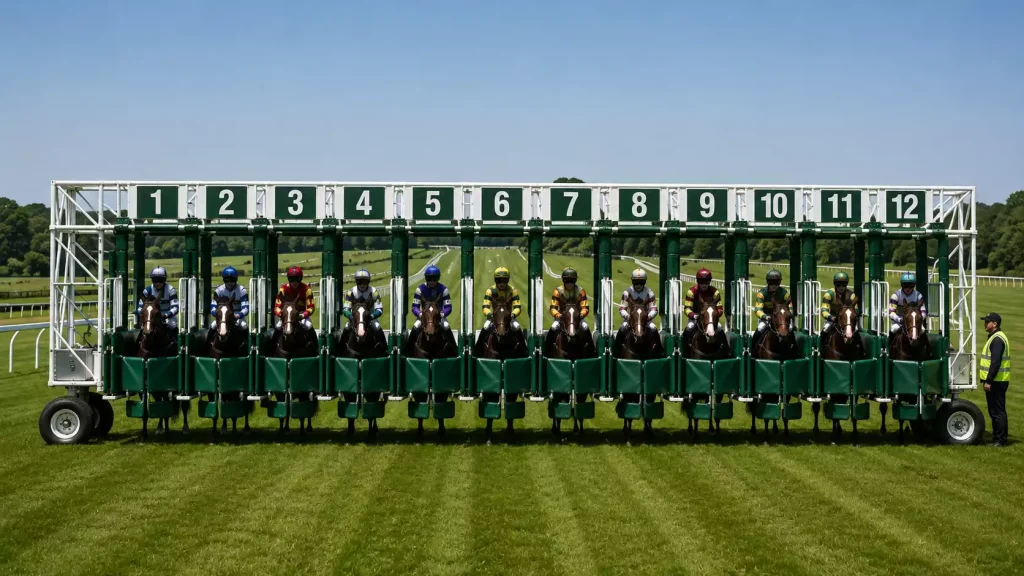
Draw bias is the statistically observable advantage that certain starting stall positions enjoy at specific tracks and over specific distances. It is one of the most reliable and most measurable factors in British Flat racing, and at some courses it is strong enough to substantially rewrite your list of fancied horses before a single piece of form analysis has been done. A well-handicapped horse drawn on the wrong rail at Chester or Beverley can run the race of its life and still finish well beaten by a moderate animal drawn favourably.
Recreational punters tend to mention draw bias as an afterthought, after they’ve made their selection on form. Experienced punters treat it as a filter that runs before form analysis – there is no point spending twenty minutes parsing the form of a horse drawn in stall 12 at Chester when the draw bias makes its chance structurally inferior to the horse drawn in stall 2. The race may still throw up surprises, but the base-rate probabilities are set by where each runner emerges from the gate.
Which courses it matters at: the major racecourses.
What Draw Bias Actually Is
When you see a card listing horses with stall numbers next to their names – “draw 1”, “draw 12”, and so on – those numbers refer to the starting stalls from which each horse will be loaded. Stall 1 is on the inside rail at most British courses; the highest-numbered stall is on the outside. The exact orientation depends on the course configuration and which side of the track the running rail sits on.
Draw bias emerges when the stall position systematically affects a horse’s chance of winning, independent of its underlying form. The mechanism is usually geometric: at tracks with bends close to the start, horses drawn on the inside have a shorter distance to the rail and a better chance of taking up an economical position. At sprint tracks with cambered going, one side of the track may simply ride faster than the other. At long straight tracks, a strong crosswind can advantage horses drawn on the sheltered side.
The bias is statistically measurable. If you take every five-furlong handicap run at Chester over the past five years and group the winners by draw band – stalls 1-3, 4-6, 7-9, 10+ – the low-draw band typically produces several times more winners than the high-draw band, even after correcting for the fact that more horses run from low draws. The pattern is not noise; it is signal, replicable across seasons.
The strength of the bias varies dramatically by track, distance and conditions. At York’s straight six-furlong, the draw bias is minimal in normal going – the course is wide enough and the start far enough from the finish that no stall position has a structural advantage. At Beverley’s five-furlong, the bias is overwhelming and frequently decides races before they reach halfway. Knowing the bias profile of every track at every distance is one of the genuinely useful analytical projects available to a UK Flat punter.
Why Draw Bias Exists
The reasons draw bias exists are mechanical and largely uncontested. The dominant factor is the distance from the starting stalls to the first bend. On a track where the first bend is 200 metres after the stalls, every horse can choose its position before reaching the bend, and the draw has minimal effect. On a track where the first bend is 50 metres after the stalls, horses on the inside have a structural advantage because they reach the bend tracking the rail without having to manoeuvre across the track.
The second factor is the camber and surface of the running rail. Many British turf tracks have a slight slope from the inside to the outside, or vice versa, often combined with differing soil quality across the width of the course. Horses running on the faster side of the track – usually the inside, sometimes the outside depending on watering and weather – gain a small per-stride advantage that compounds over the duration of the race.
The third factor is the strength of the early pace. In races with multiple front-runners, horses drawn close together may compete for the lead and burn each other out, leaving the race for horses drawn further away. Conversely, in races with only one obvious front-runner, that horse’s drawn position becomes critical – they need to be able to reach the rail without losing ground, and a low draw makes this much easier than a high one.
Wind is the fourth and most overlooked factor. A strong crosswind on a straight course can give horses drawn on the sheltered side a measurable advantage over the duration of the race. The wind direction can flip the bias in races that would otherwise be neutral, and looking at the weather report on race day is a routine part of draw analysis on straight-course meetings.
The Royal Ascot meeting illustrates the issue cleanly. Royal Ascot draws an average of 54,984 spectators per day across its five days, and the round mile and round six furlongs at Ascot produce visible draw effects that punters notice in real time – a fast-finishing horse drawn wide who can’t quite get to the rail in time is one of the most familiar sights of the meeting.
British Tracks with the Strongest Bias
Chester is the canonical example. The course is a tight, left-handed, almost circular configuration of just over a mile in circumference, with bends throughout and a short straight. Almost every race at Chester favours horses drawn low – the bias is strong at five furlongs, very strong at six furlongs and a mile, and remains meaningful even at the longer distances. Backing horses drawn in stalls 1-4 at Chester, while ignoring high-drawn horses regardless of form, produces a positive return in many race types over multi-year samples.
Beverley over five furlongs is another extreme case. The straight five-furlong sprint course rises sharply, and horses drawn on the stand (high) side traditionally enjoyed a significant advantage on the faster ground there. The strength of this bias has fluctuated with watering and ground management, but it remains one of the references for “draw matters” in UK sprinting.
Goodwood produces draw effects depending on distance. The five-furlong start at Goodwood favours low draws because the run to the rail is short. The seven-furlong race over the round-and-straight configuration produces different effects again. Goodwood’s track shape means draw analysis here requires care – the bias varies more by distance than at almost any other British course.
Lingfield’s straight five-furlong all-weather track on the Polytrack surface produces a clear stand-side bias in most conditions, with horses drawn high consistently outperforming low-drawn rivals. The pattern is consistent across seasons because the synthetic surface doesn’t vary with weather the way turf does.
Bath, Epsom, Doncaster, Sandown and Pontefract all produce measurable draw biases at specific distances. The general principle is that smaller, tighter, more undulating tracks produce stronger biases than wide, level galloping circuits. York’s straight six is famously neutral; Newmarket’s wide track produces only modest bias even in big sprint fields. Knowing which courses ride how matters, and is part of why total UK racecourse attendance reached 5.1 million in 2025 – the variety of courses and their characters is one of the genuine attractions of British Flat racing.
The full picture is in our guide to UK horse racing betting basics.
Using Draw Information in Practice
The first practical step is to consult a draw bias reference before assessing any field at a known biased course. Several publishers maintain seasonal draw bias guides for British tracks, and the major form publications include draw notes alongside the cards. Treat these as the starting point, not the final word – biases can shift seasonally, and conditions on the day matter.
The second step is to weight the draw against the race conditions. In a six-runner sprint at Chester, a horse drawn in stall 1 has almost no disadvantage to overcome relative to its rivals – the field is small, the bends manageable, the bias matters less. In an 18-runner sprint at Chester, the same draw is critical, because the run to the rail is contested by a large field and low draws can save many lengths in the first furlong.
The third step is to look at how the early pace will likely shape. A race with multiple confirmed front-runners drawn together creates pace pressure that benefits horses drawn away from the cluster. A race with one obvious front-runner drawn poorly may produce a slow early pace that allows horses with stamina to come from off the pace, partially neutralising the bias.
The fourth step is the on-the-day check. Watering on the morning of racing changes the going across the track and can flip a bias overnight. Significant wind changes from the morning forecast can do the same on straight courses. The smart on-course punter watches the early races at a meeting specifically to confirm whether the published bias is operating that day before committing serious stakes on later races.
Finally, draw bias is most powerfully used in combination with other reading techniques. A well-handicapped horse drawn favourably is a stronger bet than the same horse drawn poorly; a poorly handicapped horse drawn favourably is rarely a bet at all. The bias adjusts your probability estimates rather than replacing them. For the wider context of how the British racecourse network produces these distinct racing characters, see our guide to the major UK racecourses and their tracks.
FAQ
Does draw bias affect every race at a biased course?
No. Bias strength depends on distance, field size, going conditions and the day"s racing pattern. A small field at a normally biased course may neutralise the bias entirely, while a big field on a typically neutral course can produce a temporary bias from sheer congestion. Treat published bias data as a baseline, adjusted for the specific conditions of each race.
Can draw bias be exploited profitably?
In principle yes, but margins are tight. Pure draw-based blind betting strategies – backing every low-drawn horse at Chester regardless of form – have produced positive returns in some samples and negative in others. The reliable use of draw bias is as a filter combined with form analysis, identifying horses where the bias and the form both point in the same direction and where the price hasn"t fully reflected both.
Why don"t the bookmakers price out draw bias completely?
The major bookmakers and exchange traders do incorporate draw bias into their prices, particularly at well-known biased courses. But the bias varies with conditions, field size and race shape in ways that aren"t always fully captured by the opening prices. Recreational punter betting can also push the prices on heavily backed horses regardless of draw, leaving small but persistent margins for disciplined draw analysis.
Working Draw Into Your Routine
Draw bias is one of the few free, public, statistically validated edges available to a recreational UK punter. The information is in front of every reader of a racecard – the stall numbers are printed on the page – and yet the analysis is consistently underweighted relative to its real predictive value. Build a working knowledge of the major biased tracks, check the draw before form for any race at one of them, and you will find yourself making sharper decisions in less time than punters who treat draw as a footnote rather than a foundation.