
Betting Exchanges: Back and Lay Explained
Best Horse Racing Betting Sites – Bet on Horse Racing in 2026
 Available in US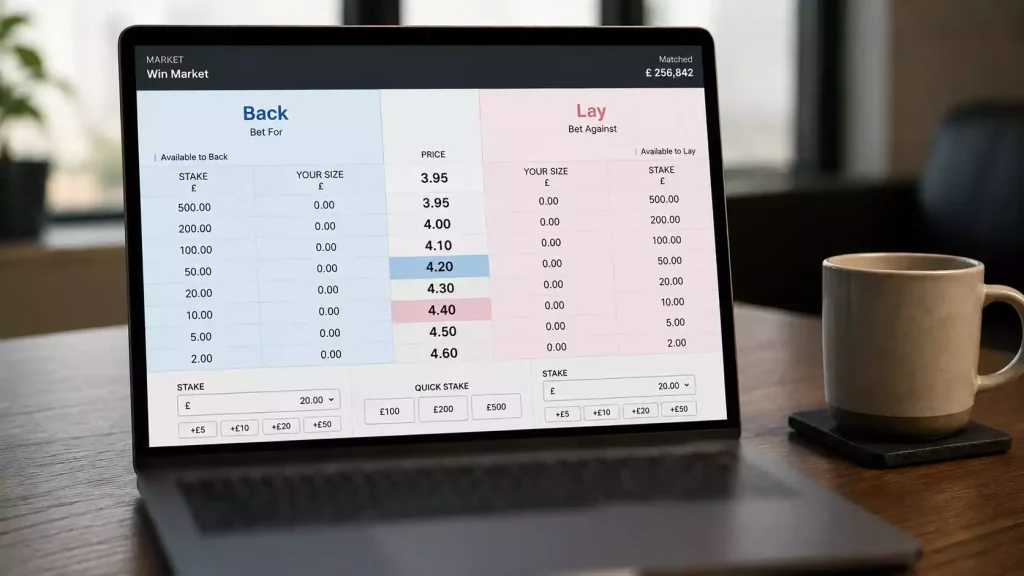
Where You Become the Bookmaker
The first time I laid a horse on a betting exchange I felt like I had just handed someone the keys to my house. The price was 8/1, the field was a competitive 12-runner handicap, and I had decided that the favourite was overpriced and would not win. I laid £20 of the horse at 8/1 – which, in exchange terms, meant I was committing £160 to pay out if it did win. The horse finished third. I kept the £20. And I went home with the slightly disturbing realisation that for the first time in twenty years of betting, I had been the bookmaker rather than the punter. The same realisation that has reshaped British betting since the late 1990s when the first exchanges opened: the punter and the bookmaker can swap roles at any time, and the price moves accordingly.
The exchange model is a different animal from the traditional bookmaker. Instead of betting against an operator who sets the prices, you bet against another exchange user who is taking the opposite side of your wager. The exchange operator’s role is to match buyers and sellers – punters who want to back a horse with punters who want to lay it – and to collect a commission on net winnings as the price of running the market. Total remote betting GGY of £7.8 billion in the financial year to March 2025 includes exchange revenue, though exchanges as a category make up a smaller share of total GGY than traditional sportsbooks.
Exchange prices are decimal: odds formats explained.
How an Exchange Works
The core mechanic is the order book. For any race, the exchange displays the current best back price and the current best lay price for each horse, alongside the volumes available at those prices and at the next several price points. If you want to back a horse at 5/1, you can either accept the displayed lay price – meaning you take 5/1 as offered – or you can post a request to back at 6/1, hoping someone will come along later to lay the horse at that better price.
The two sides have specific meaning. “Backing” a horse on an exchange is the same as backing it at a traditional bookmaker – you stake an amount, and if the horse wins, you collect the stake plus the winnings at the price you took. If the horse loses, you lose the stake. “Laying” a horse is the opposite – you accept a stake from someone backing the horse, and you commit to paying them their winnings if the horse wins. If the horse loses, you keep their stake. In effect, when you lay, you become the bookmaker for that specific trade.
The liability on the lay side is the part that catches new exchange users. Laying £10 on a 9/1 shot means committing £90 in liability – the amount you have to pay out if the horse wins. The £10 is what you collect if the horse loses; the £90 is what you risk. The maths is straightforward but the visual impact of seeing your liability figure on an exchange screen is jarring the first few times you encounter it, because it is a multiple of the headline stake you are placing.
Markets on an exchange are typically displayed both pre-race and in-running. Pre-race markets settle when the race goes off and the exchange matches positions against the final pre-race price. In-running markets continue trading as the race is run, with prices shifting in real time as horses progress around the course. The in-running market is the place where exchange users can hedge open positions, lock in profits, or unwind losing bets before the result is decided.
Lay Betting
Lay betting is the structural innovation that exchanges brought to British betting. The ability to bet on a horse losing – against any horse, in any race – has no direct equivalent in the traditional bookmaker market. The closest fixed-odds analogues are markets like “without the favourite” or specific antepost trades, but those are tightly constrained whereas lay betting on an exchange is universally available on every priced horse.
The natural use case for lay betting is when you have a strong opinion that a specific horse will not win. Perhaps the market favourite is over-bet by casual money, perhaps a fancied horse has weak form on the going, perhaps a horse is running on an unsuitable course. A lay bet lets you express that view directly, rather than having to back every other horse in the field as a clumsy substitute.
The probability arithmetic favours lay betting on certain kinds of horses, particularly short-priced favourites in competitive handicaps. A 2/1 favourite has, by implied probability, a 33 % chance of winning – which means a 67 % chance of losing. A lay bet on that horse pays out 67 % of the time, with the cost that the 33 % loss case requires paying out twice the stake. The break-even calculation is straightforward: if the true probability of the horse winning is less than 33 %, the lay is +EV in the long run.
The trap is over-confidence. Most casual punters who try lay betting do so because they have strong feelings about a particular favourite. Strong feelings are not the same as accurate probability estimates, and the long-run records of casual lay bettors tend to be unkind. Lay betting is most useful when applied systematically – laying short-priced favourites in races where the favourite-longshot bias is documented to be at its strongest – rather than as a vehicle for opinionated one-off trades.
Commission Instead of Overround
The economic model of an exchange differs fundamentally from a traditional bookmaker. A bookmaker sets prices that build in an overround margin – the prices implied across a race add up to more than 100 % probability, with the excess representing the bookmaker’s expected profit. An exchange takes commission on net winnings – typically between 2 % and 5 % depending on the operator and the punter’s volume – and the prices in the market reflect peer-to-peer agreement without an overround margin baked in.
The practical implication is that exchange prices, before commission, are typically better than bookmaker prices for the same horse at the same time. A horse displayed at 5/1 at a traditional bookmaker might be available at 5.5/1 to 6/1 on an exchange just before the off. The exchange punter who consistently bets at these slightly better prices gains an edge of a few percentage points across a betting season – and over thousands of bets, that edge compounds meaningfully.
The catch is that the commission applies to net winnings, which trims the realised edge. A 5 % commission on a £100 winning bet at 5/1 means you collect £475 in net winnings rather than £500. The commission scales linearly with how much you win, so high-volume profitable punters end up paying meaningful sums in commission over a year. Some exchanges offer commission discounts to punters who hit volume thresholds, structured as loyalty tiers that reduce the commission rate from the standard rate down to 2 % or sometimes lower at high-volume tiers.
The £1.6 billion drop in online betting turnover on UK racing since 2022 – the so-called “£3 billion black hole” when adjusted for inflation – has impacted both exchanges and traditional sportsbooks, though the impact has been distributed differently across the market. Exchanges tend to retain their professional and semi-professional users through downturns because the structural advantages of better prices and lay flexibility do not depend on bookmaker margin. The casual segment, which uses traditional sportsbooks more heavily, has shrunk faster.
The full picture is in our guide to UK horse racing betting basics.
Liquidity and Market Depth
Liquidity is the practical constraint that shapes exchange betting at smaller stakes and longer prices. The displayed back price of 6/1 on a horse might have only £25 available at that price, with the next layer of liquidity at 5.5/1, and the layer after that at 5/1. A punter wanting to back £100 at the displayed price will either accept successively shorter prices as they consume the available liquidity, or place a “request” order at the better price and wait for someone to match it.
The major British racing markets – Saturday handicaps at top meetings, the four Cheltenham championship races, the Grand National, Royal Ascot Group Ones – have substantial liquidity, often into the hundreds of thousands of pounds matched per market. A punter staking up to £500 in these markets will rarely struggle to get the displayed price. The midweek markets – Monday afternoon at Wolverhampton or Plumpton, evening AW racing at Kempton – have much thinner liquidity, sometimes only a few hundred pounds matched in total on a regular handicap, and punters at any meaningful stake size will find themselves moving the price as they bet.
Liquidity also affects the lay side. Laying a horse requires someone willing to back it at your price, and on lightly-traded markets the available volume on the back side can be limited. A lay request at a particular price might sit unmatched for hours before the off, only to be matched in the final seconds as the market thins out around closing. The Boxing Day Betfair pre-off win market generated approximately £11.2 million in turnover in 2024, down 14 % from £13 million in 2023 – a meaningful indicator of how even the highest-volume racing exchange days have been affected by the wider downturn.
In-Play on Exchanges
The in-running market is where exchanges differ most starkly from traditional bookmakers. Most fixed-odds operators offer some in-play betting on horse racing, but with much wider margins and frequent market suspensions during the race. Exchanges run a continuous in-running market with prices updated multiple times per second as the race progresses, and the spreads between back and lay prices typically remain tight throughout.
In-running on exchanges is also where the picture-delay issue bites hardest. The signal showing the race on TV or in your browser is typically one to several seconds behind the live action on the course. On-course exchange users – who can see the race with their own eyes – have an information advantage over off-course users who are watching delayed pictures. This delay has driven a small but real edge for on-course in-play traders, particularly in the closing furlongs of a race when prices move fastest.
For most punters, in-running betting is best treated as a tool for hedging or unwinding pre-race positions rather than a primary betting structure. If you backed a horse at 8/1 before the race and it is trading at 2/1 in-running at the second-last fence, laying off some of the position can lock in profit regardless of what happens in the final 200 yards. If you laid a horse at 3/1 and it is now drifting to 7/1 because of a poor start, backing some of the position back can cap the maximum liability. The flexibility is real and useful – but the trap of acting on emotional reading of a race is also real and is where most casual in-play traders lose money.
How does commission on a betting exchange compare to bookmaker overround?
On a typical horse racing market, a traditional bookmaker"s overround margin is around 12 to 18 %, distributed across all horses in the race. The exchange charges a commission of 2 to 5 % on net winnings, with no margin built into the prices themselves. For winning punters, the exchange model is cheaper in total cost per pound staked, even after commission. For losing punters, the comparison reverses because commission only applies to net winnings, while overround applies whether you win or lose.
Is liquidity on UK horse racing exchanges consistent across all meetings?
No, liquidity varies dramatically by meeting and by individual market. Saturday handicaps at major fixtures, the championship races at Cheltenham and Aintree, and Royal Ascot Group Ones have substantial liquidity into six and seven figures. Weekday all-weather meetings, smaller National Hunt cards in mid-summer, and lower-grade fixtures have much thinner liquidity, sometimes only a few thousand pounds matched in total on regular markets. Punters staking serious money on these thinner markets will move the price as they bet, and request orders at better prices may sit unmatched.
Exchanges are one of the three main routes to placing a horse racing bet in the UK, alongside traditional sportsbooks and the Tote pool system. The pricing mechanics that underpin all three – fractional, decimal, and the implied probabilities behind each – are worth understanding regardless of which route you use. I have walked through those mechanics in the broader piece on how UK horse racing odds work and what the prices actually mean.
Articles
Created by the "" editorial team.