
Tote Bet, Placepot, Jackpot and Scoop6
Best Horse Racing Betting Sites – Bet on Horse Racing in 2026
 Available in US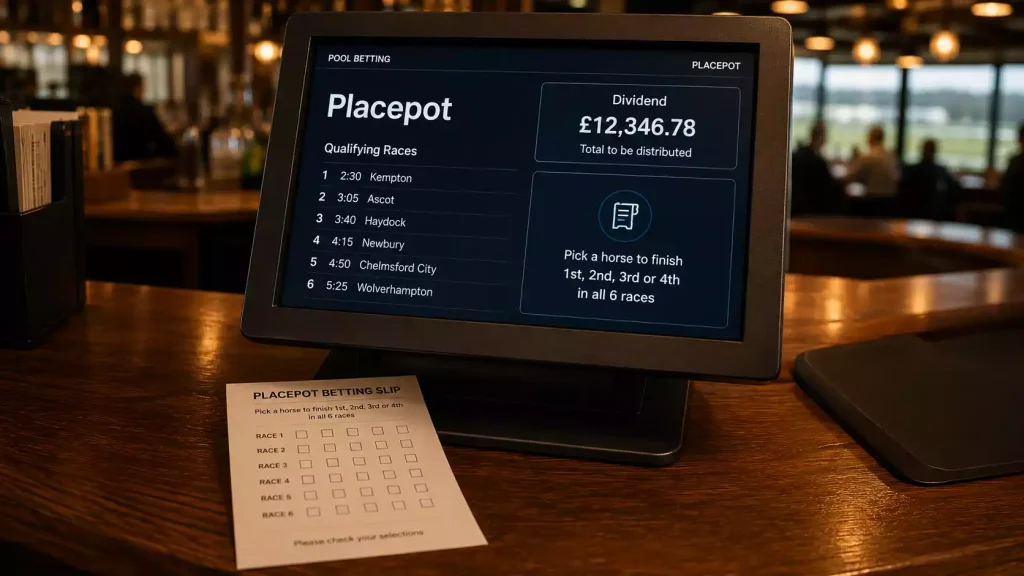
Pool Betting Plays a Different Game
The first time I won a Placepot it was for £170 on a £2 stake at Newmarket on a cold Tuesday in November. I had been there since the first race, working through racecards in the bar, and when the sixth race result confirmed my last horse had finished in the places, I looked at the dividend board, saw the number, and genuinely thought there had been a typing error. There had not. That is what pool betting can do. It is the only structure in British racing where you can stake the equivalent of a pub round and walk out with the kind of return that fixed-odds bookmakers would only ever offer at much longer odds.
The Tote – formally the Horserace Totalisator Board, now operating commercially as Tote and on-course as Britbet – runs the pool betting system on British racing. It is a fundamentally different mechanism from the fixed-odds bookmaker market most punters use online. Instead of betting against a bookmaker at a quoted price, you bet into a shared pool of money. After the race, the pool is distributed to the winners – minus a deduction for the operator – and divided across the winning tickets. There is no quoted price. There is only a dividend, set after the fact by maths.
The fixed-odds alternative: types of horse racing bets.
How Parimutuel Betting Works
The mechanics of parimutuel betting – the international name for pool betting – are best explained with a worked example. Say a Tote Win pool on a particular race collects £100,000 in stakes across all the horses in the race. The Tote applies a deduction – historically around 16.5 % for Win pools, varying by bet type – to fund the operator’s costs and contributions to the levy and to racing prize money. That leaves around £83,500 to be paid out to winning tickets.
Of the £100,000 originally staked, say £20,000 was staked on the winning horse. The £83,500 pool is now divided among everyone who had a winning ticket – so the dividend per £1 stake is £83,500 divided by 20,000, which is £4.175. The Tote rounds this to the nearest 10p in most cases, so the dividend displayed would be £4.10 per £1 stake including the stake.
The key insight is that the dividend depends entirely on what the rest of the pool did, not on any pre-race calculation by an operator. If only £5,000 had been staked on the winning horse out of the same £100,000 pool, the dividend would be £83,500 divided by 5,000, which is £16.70. The less the rest of the pool fancied the horse, the bigger your dividend if you happen to be one of the few backers.
This creates a distinctive pricing dynamic compared to fixed-odds markets. Fixed-odds bookmakers set prices based on their professional assessment of probability plus their overround margin. Tote dividends are set by the collective opinion of everyone else who staked into the pool. The two prices can diverge significantly, particularly on horses where the public has strong feelings – favourites are often relatively short on the Tote because casual money piles in, while well-fancied longshots can pay better on the Tote than at fixed odds because the wider public has not noticed them.
One HBLB chair captured the broader trend of pool betting in the UK market succinctly: “We will exercise appropriate prudence in expenditure decisions and maintain sufficient reserves as bookmakers’ increased profits are being generated from falling turnover. It remains to be seen whether this trend will continue in the longer term.” The Tote sits in a slightly different position from fixed-odds operators in this market dynamic, because its income depends on pool size rather than bookmaker margin – and the pool sizes on British racing have been broadly stable while bookmaker turnover has fallen.
Tote Win and Tote Place
The two basic Tote products are Tote Win and Tote Place. They mirror the fixed-odds win and place markets but operate on the pool system.
Tote Win: you stake on a single horse to win the race, the winning pool is divided among everyone who backed that horse, dividend declared per £1 stake. The historical deduction is around 16.5 %. Tote Win dividends are often comparable to fixed-odds SP but can be meaningfully better or worse depending on how the rest of the pool bet. The most useful situations for Tote Win betting are races where a horse you fancy is being overlooked by the casual public – your dividend will be relatively generous because few others in the pool backed the same horse.
Tote Place: you stake on a single horse to finish in the place positions – first, second, third, or in some cases fourth depending on field size. The dividend is calculated by dividing the place pool (minus deduction) among the winning tickets across all the placed horses. Note that this is different from each-way at fixed odds: with Tote Place, you do not bet on win and place separately; you bet only on the place portion, with no win-portion settlement. The dividends are lower than equivalent each-way place returns at fixed odds for shorter-priced horses, but can be considerably better on longshots and lightly-supported horses.
The on-course Tote is operated through the Britbet partnership at most British racecourses. Britbet was established to consolidate on-course pool betting under racecourse ownership rather than the previous third-party operation. Many racecourse cards now feature an enhanced Tote Win or Tote Place dividend on certain races as a customer-acquisition lever, though the underlying mathematics still depends on pool size.
Placepot
This is where pool betting starts to become genuinely interesting. The Placepot is a multi-race pool bet that requires you to pick a horse to finish in the places (first, second, third, sometimes fourth) in each of the first six races at a designated meeting. The pool is collected before the first race; the deduction is applied; the remaining pool is divided among the holders of winning tickets after the sixth race result.
The Placepot’s appeal is structural. Picking a placed horse in any one race is a moderate-probability event – somewhere between 40 % and 70 % for any reasonable selection in a typical field. Combining six such selections compounds the difficulty, but not as steeply as a six-fold accumulator does. If your average place probability per race is 50 %, the probability of all six placing is 0.5^6, which is about 1.6 %. A dividend that pays out at much higher than 1.6 % implied probability – say, £100 on a £1 stake – represents genuine value on those probabilities.
The Placepot also offers “perm” structures: rather than picking a single horse in each race, you can pick multiple horses in a race and have your slip cover all combinations. A 1-horse / 2-horse / 1-horse / 1-horse / 2-horse / 1-horse perm covers four lines (1 × 2 × 1 × 1 × 2 × 1 = 4), each requiring its own £1 unit stake for a £4 total slip. Perms can rapidly scale into the hundreds of lines on a six-race card with multiple selections in several races.
The Placepot is most attractive on midweek meetings where the pool is modest and the field sizes are smaller, because the casual public’s preference for favourites concentrates the pool on a smaller subset of selections – leaving room for a careful punter who picks soundly-place-priced horses to harvest disproportionate dividends. On major weekend cards the Placepot pools are large and the dividends are more efficient.
The full picture is in our guide to UK horse racing betting basics.
Jackpot and Scoop6
The Jackpot raises the difficulty significantly. To win the Jackpot you must pick the winner of all six designated races at a meeting – not the placed horse, the winner. The pool collected before the first race is divided among holders of winning tickets after the sixth race. If no ticket wins, the pool rolls over to the next meeting.
The compounding probability is brutal. Even at an average win probability of 25 % per race, the probability of picking all six winners is 0.25^6, which is about 0.024 %. Most Jackpot pools roll over multiple times before a ticket hits, which is precisely the design intent – the rollovers build the pool to a size that justifies the long-odds proposition.
The Scoop6 is the largest and most ambitious of the regular Tote pool bets. It requires you to pick the winner of six televised Saturday races on a designated card – typically a single major Saturday across multiple meetings, with the races announced in advance. The Scoop6 pool is built across the entire week leading up to Saturday, and rollovers from previous weeks can carry forward.
The Scoop6 pool has occasionally rolled into seven-figure territory during periods of multiple consecutive rollovers, attracting media coverage and casual money. The Boxing Day Scoop6 historically attracts particularly large pools – and the fall in racing turnover seen across the wider market does not always translate to the Scoop6, where the rollover dynamic creates a buzz that draws in non-regular punters.
The Quadpot is the smaller cousin of the Placepot, requiring placed horses across the third, fourth, fifth, and sixth races at a meeting – four races instead of six. The dividends are smaller because the difficulty is lower, but the bet is a useful entry point for punters new to the pool format who want to test the format without committing to a six-race slip.
Britbet On-Course
Britbet handles the on-course pool betting at most major British racecourses. The on-course pool is structurally a separate pool from the off-course Tote pool that captures online and high-street stakes, though the dividends are typically calculated and published together. For punters at the course, Britbet windows accept stakes on Tote Win, Tote Place, Placepot, Jackpot, Quadpot, and the various Tote forecast and tricast products.
The £14 billion in historical annual turnover on British racing – captured before the more recent decline in fixed-odds betting – included a meaningful share of on-course pool betting, particularly at major festival meetings where on-course punters dominate the pool. The Royal Ascot Scoop6 has been a famously large pool in some recent years, attracting attention partly because of the on-course concentration of larger-stake punters.
On-course pool betting has a slightly different dynamic to off-course pool betting. The on-course punter has more information – visible going, parade ring observations, late market movements – and the on-course pool is therefore generally a sharper pool than the off-course equivalent. Dividends on on-course pools can be slightly less generous than off-course pools on the same races, because the on-course money is concentrated on the genuinely-fancied horses by people who have seen them go to post.
What is the typical strategy for winning a Placepot?
The most successful Placepot strategies focus on identifying solid place chances rather than picking winners. A horse priced around 6/1 to 12/1 with a strong record of finishing in the placings is often a better Placepot selection than a 2/1 favourite, because the favourites compress the pool and reduce the dividend. The perm structure – picking multiple horses in races where you have less conviction – lets you spread risk across a card while concentrating on stronger selections in races you read better. Pool size matters too: midweek Placepots with smaller pools and less casual money typically pay better dividends per unit of skill than major weekend cards.
How large can the Scoop6 pool get?
The Scoop6 has reached seven-figure pools on multiple occasions, particularly after consecutive rollovers when no winning ticket has been struck for several weeks. The Boxing Day Scoop6 has historically attracted some of the largest pools of the year, and major spring meetings such as Cheltenham and Aintree Saturdays have seen pools well into the high six-figure range. The pool size depends on rollovers, the perceived prestige of the day"s racing, and media coverage building public awareness in the days before the Saturday.
Pool betting through the Tote is one of two main alternatives to placing fixed-odds bets directly with a bookmaker. The other – placing bets peer-to-peer against other punters rather than against an operator – is the betting exchange model, which operates on different mechanics again. The contrast is worth understanding in detail, which I have walked through in the practical guide to betting exchanges and how back-and-lay works.