
Black Market Betting in the UK: Size, Risks and Signals
Best Horse Racing Betting Sites – Bet on Horse Racing in 2026
 Available in US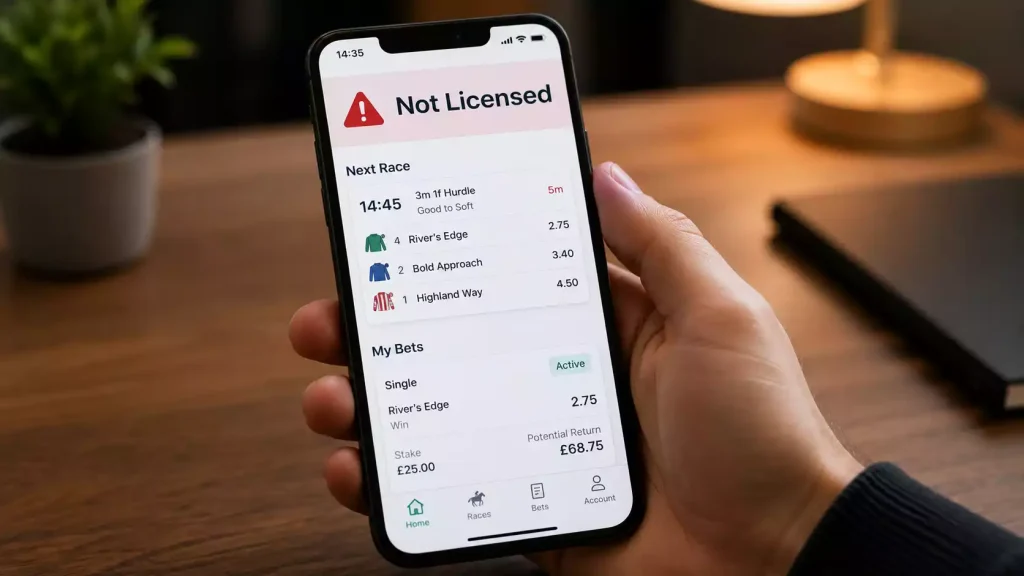
The “black market” in UK gambling refers to the segment of offshore, unlicensed operators that serve British customers without holding a UK Gambling Commission licence. These sites don’t pay the Horserace Betting Levy, they don’t apply affordability checks, they don’t comply with UK consumer protection rules, and they don’t contribute a penny to the funding of British racing. They have grown from a marginal nuisance to a measurable competitor inside half a decade, and any honest discussion of the UK betting market in 2026 has to deal with their presence rather than pretend they aren’t there.
For a punter, the black market is a poisoned chalice. The prices may be longer, the limits higher, the checks lighter – but the moment something goes wrong, you have no recourse, no ombudsman, no regulator to escalate to. The sites operate from jurisdictions where UK law has limited reach, and the consequences of disputes, account closures, withheld winnings or stolen funds fall almost entirely on the customer. Knowing what the black market is, how big it has grown, and how to identify an unlicensed operator is now an essential piece of literacy for anyone betting online in Britain.
What the licensed side looks like: UK betting regulation.
How Big the Black Market Actually Is
The most striking number in the UK gambling sector right now is the rate at which the unlicensed segment has grown. Independent analysis by Yield Sec, a market intelligence firm tracking online gambling, found that unlicensed operators now account for approximately 9% of the UK online gambling market, representing around £379m in gross gambling yield in the first half of 2025 alone. That figure was less than 0.5% as recently as 2020.
The trajectory tells the story. A market segment that was rounding error five years ago is now a sizeable competitor to the licensed sector. The Betting and Gaming Council commissioned its own research and put the annual turnover figure for unlicensed UK gambling at approximately £2.7bn – a number that includes all gambling categories, not only horse racing, but which gives the order of magnitude of the displacement involved.
The growth has been particularly concentrated among higher-staking punters. The Racing Post’s Big Punting Survey, which captured responses from around 10,000 active punters, found that roughly one in three of those who stake £1,000 or more per transaction had used an unregulated site in the previous twelve months. Among the recreational punter base the proportion is much lower, but among the higher-engagement segment that historically underwrote the economics of British racing, the migration has been substantial.
These numbers should not be over-precise – measuring an offshore, unregulated market is inherently imperfect, and different methodologies produce different totals. But the directional trend is consistent across every credible source. The unlicensed market is growing, and it is taking the high-staking, high-engagement portion of the punter base disproportionately.
Why Punters Move Offshore
The reasons punters drift to unlicensed operators are not mysterious. They are, in roughly descending order of frequency: friction on the regulated market, account closures or stake limits at UK bookmakers, longer prices and higher liquidity, and dissatisfaction with affordability checks.
The friction issue is real. A punter who has been asked three times in six months for bank statements, payslips and source-of-funds declarations may decide that an offshore alternative offering frictionless deposits is worth the regulatory risk. The decision isn’t always rational – the punter is trading legal protection for convenience – but it is comprehensible.
Stake limits and account closures are another driver. UK-licensed operators commonly limit winning punters or close their accounts entirely, particularly those identified as professional or near-professional bettors. These customers, often the most sophisticated in the market, find that the only way to continue betting at meaningful stakes is to move offshore. The unlicensed market is happy to take their business – and to pay out, at least until a dispute arises.
Longer prices matter to those operating on slim margins. An offshore book that doesn’t pay levy, doesn’t pay UK gambling duty and operates without the overhead of compliance can offer prices marginally longer than the licensed market on key races. For a high-volume punter, even a 2% improvement in average prices compounds significantly across a year’s betting.
The affordability check threshold reductions of 2024 and 2025 – first to £500 net monthly deposits, then to £150 – accelerated the migration. The economic argument is simple: if a regulated operator restricts your access to £150 a month without enhanced checks, and an unregulated operator imposes no such limit, the friction differential becomes a powerful pull.
The full picture is in our guide to UK horse racing betting basics.
The Risks You’re Actually Taking
The reasons not to use unlicensed operators are not abstract. They are tangible, recurring and well-documented. The most obvious is the absence of legal recourse if something goes wrong. A UK-licensed bookmaker who refuses to pay a winning bet can be escalated to the Independent Betting Adjudication Service or, in serious cases, to the Gambling Commission. An offshore operator who refuses to pay has no equivalent oversight, and your only options are direct dispute with the operator and reputational pressure through public complaints – neither of which has reliable outcomes.
Account security is another concern. Unlicensed operators are not bound by UK data protection requirements as enforced under domestic law, which means your financial details, identity documents and betting history sit on systems whose security and use you cannot meaningfully audit. There have been cases of unlicensed sites disappearing overnight with customer balances unrecovered.
The consumer protection framework that UK punters take for granted – deposit limits, self-exclusion tools, reality checks, time-outs – doesn’t exist on most offshore sites. For a punter who is in control, this absence may seem like a feature rather than a bug. For a punter who is starting to experience harm, it is a removal of the safety architecture designed to catch problems before they become crises.
Grainne Hurst, the chief executive of the Betting and Gaming Council, has been blunt about the industry view of offshore competition: “These parasite operators don’t pay tax, don’t care about safer gambling, and do not contribute a penny to the levy.” That language captures the regulated industry’s frustration, but it also captures a fundamental economic reality – every pound bet offshore is a pound that doesn’t fund British racing, doesn’t fund harm prevention, and doesn’t contribute to the public revenue the regulated industry pays.
The legal risk to the individual punter is, in practice, low – the Gambling Commission’s enforcement focus is on operators rather than customers – but the financial and personal-data risks are real and have produced documented cases of harm.
How to Spot an Unlicensed Operator
The signals that a site is unlicensed are not always obvious, particularly because offshore operators often display fake licence references or use white-label arrangements that imitate the appearance of regulation. There are some reliable checks that take less than a minute to perform.
First, check the Gambling Commission’s public register. The Commission publishes a searchable list of every licensed operator, with the trading names and websites covered by each licence. If the site you’re considering doesn’t appear on that register, it is not UK-licensed, regardless of what it claims on its homepage.
Second, check the licence number displayed in the site’s footer. UK-licensed operators are required to display their account number and a link to the Commission’s register. The licence number is in a specific format – typically a five-digit number followed by other identifiers. Numbers that don’t match this pattern, or that link to non-Commission pages, are red flags.
Third, look at the dispute resolution clauses in the site’s terms. UK-licensed operators must specify an Alternative Dispute Resolution provider – typically IBAS or eCOGRA. If the terms route disputes only through the operator’s internal process, or through a tribunal in an offshore jurisdiction, the site is not under UK regulation.
Fourth, look for the gambling-harm support footer. UK-licensed operators must display links to GAMSTOP, GamCare and BeGambleAware. The absence of these links, or links that go to dead pages, is a near-certain indicator that the site is not licensed. For more on the support infrastructure available to UK punters, see our guide to responsible gambling tools in the UK.
None of these checks is foolproof on their own – sophisticated offshore operators imitate regulated appearances closely – but combined, they give a clear picture in almost every case. If a site looks too good to be true on its terms, it almost certainly is.
FAQ
Is it illegal for a UK customer to use an unlicensed bookmaker?
The legal framework places the burden on operators rather than customers. A UK punter using an unlicensed site is not, in itself, committing an offence under current law, but they are gambling outside the protections of UK regulation. Practically, the risk is borne by the customer rather than enforced against them, but the absence of legal recourse in disputes is the real cost.
Can I get my money back if an offshore site refuses to pay out?
In most cases, no. Without UK regulatory oversight there is no statutory adjudication mechanism. Some offshore jurisdictions have their own dispute resolution processes, but these are typically slow, expensive and unsympathetic to non-resident complainants. The realistic position is that money disputed by an unlicensed operator is rarely recovered.
Why has the unlicensed market grown so quickly since 2020?
A combination of regulatory tightening on the licensed market – particularly the affordability check thresholds of 2024 and 2025 – and improved offshore technology has made unlicensed sites both more accessible and more functional. Marketing through social channels has also expanded their visibility to UK customers, even though such marketing is itself unlawful under UK rules.
Why This Matters Beyond Your Own Account
Every pound bet through an unlicensed operator is a pound that exits the regulated economy. It doesn’t fund British racing through the levy, it doesn’t fund harm prevention through industry levies on the regulated sector, and it doesn’t contribute to the public revenue. The black market is not a victimless alternative – it transfers cost from the punter using it onto the rest of the sport’s economy, and onto the punters who remain inside the regulated system. The argument for staying licensed is not only about your own protection. It is about whether the sport you bet on continues to exist in a form worth betting on.
Articles
Created by the "" editorial team.