
Form Figures and Race Codes Decoded
Best Horse Racing Betting Sites – Bet on Horse Racing in 2026
 Available in US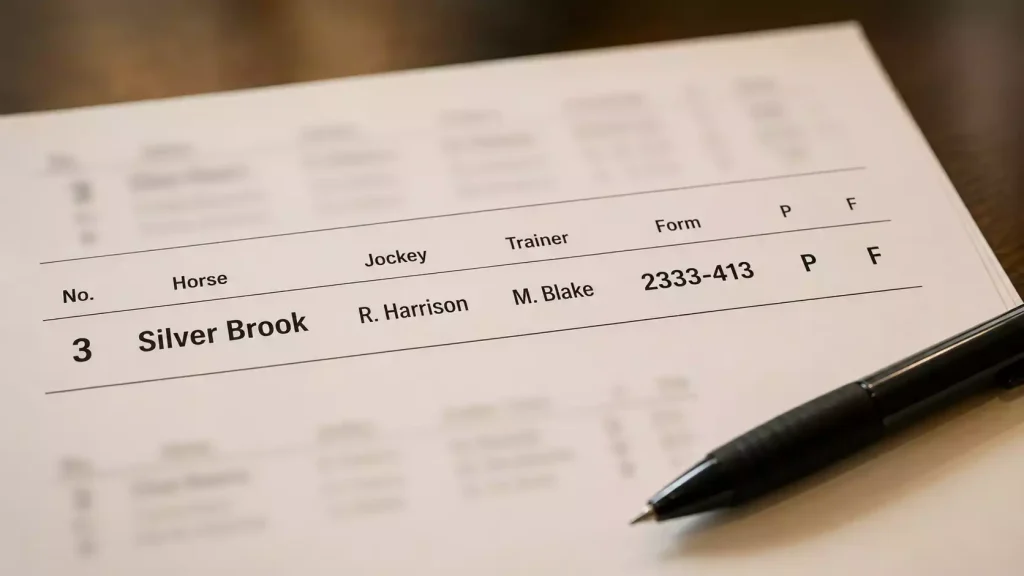
A string of characters like “2333-413” sitting next to a horse’s name looks like a cipher the first time you see it, but it’s actually one of the densest summaries in all of sport. Six to eight runs of competitive racing, distilled into eight characters, telling you almost everything you need to know about how a horse has been performing – and crucially, how it has been losing as well as winning. I’ve watched newcomers to racing stare at a racecard for ten minutes and ignore the form line completely, then bet on a name they liked. The form figures are the single most useful field on the page, and decoding them takes about an hour to learn properly.
The shorthand exists because of brutal printing economics from the era of physical racecards, but it has survived into the digital age because it works. Once you internalise what each symbol means, you can scan a 16-runner handicap in under a minute and dismiss two-thirds of the field. Given that British racing has seen total betting turnover fall by 6.8% in 2024 and 16.5% against 2022, edge is harder to come by than ever – and reading form figures faster and more accurately than the market is one of the few edges still genuinely available to the recreational punter.
The rest of the card explained: how to read a racecard.
What the Numbers Actually Mean
The numbers in a form string are finishing positions, read left to right from oldest to most recent. So “2333-413” means: two starts ago the horse was 4th, then 1st, then a separator, then 3rd, 3rd, 3rd, 2nd as the most recent run. The most recent run is always on the right-hand end of the string, immediately before the horse’s name on a UK card.
Single digits from 1 to 9 represent literal finishing positions. Anything outside the top nine is shown as “0” – meaning the horse finished tenth or worse. That’s an important distinction. A “0” is not “didn’t finish”; it’s “finished, but outside the placings most cards bother to track”. A horse with three zeroes in their last three runs has been getting round but never threatening – useful information that a finishing-position-only readout would miss.
Read sequences rather than individual digits. A horse with “5532” is on a clear upward curve – improving steadily, peaking in their most recent outing. A horse with “1334” has gone the other way – a winner now drifting backwards. These trajectories matter more than the headline number, because horses race in a state, not a state of being.
One number you should weight heavily is the most recent one, simply because fitness changes and the gap between a horse’s last run and today tells you what they’re carrying into the gate. A “2” from twelve days ago means something quite different from a “2” from four months ago, and the card will show you the date.
The Letter Codes – P, F, U, R and Their Cousins
When a horse doesn’t finish a race, the form string records why. Each letter is a one-character incident report, and they cluster around National Hunt racing where horses jump fences and hurdles – though some appear on the Flat too.
P stands for “pulled up”. The jockey has decided, mid-race, that the horse has nothing more to give and has reined them in rather than push on through obvious distress. Pulled up is a welfare decision more than a competitive one. It tells you the horse was either out of their depth, off-colour on the day, or running into trouble that made completing unsafe.
F means the horse fell. Over jumps, this is a stumble at a fence or hurdle that brought the horse to the ground. On the Flat, falls are rare but they happen – usually a clipped heel that brought the horse down. A single F in a string isn’t damning; horses fall, even good ones. Three Fs in a row is a different story and suggests jumping problems that need solving before the horse is a credible bet.
U denotes “unseated rider”. The horse stayed upright, but the jockey came off. Often this happens at a fence where the horse jumps awkwardly or twists in the air and the rider can’t hold position. From a betting standpoint, a U is less damaging than an F – the horse itself didn’t fail physically – but it still tells you something wasn’t right with the partnership or the jumping technique on the day.
R means the horse refused. They came to a fence or hurdle and declined to jump. This is the most concerning letter in the catalogue, because it can indicate a temperamental issue, a loss of confidence after a previous fall, or simply a horse who has decided racing is not for them today. A horse with an R in their last three runs needs serious vetting before they’re worth a stake.
B covers “brought down”. The horse was on its way round the course when another faller blocked their path and brought them to the ground. This is bad luck rather than bad form – a brought-down line should not count against the horse in your reading. Underline it as “didn’t get a chance” and move on.
There’s also D for disqualified (rare, usually after a stewards’ inquiry overturned a result), O for “ran out” (the horse left the course mid-race), and S for “slipped up”. Each is a self-contained story that wants reading alongside the dates and venues.
The full picture is in our guide to UK horse racing betting basics.
Dashes, Slashes and the Quiet Gaps
The punctuation in a form string is not decoration. A dash separates seasons; a slash separates years. So “2333-413” with a dash tells you the four most recent runs came after a break that crossed a season boundary – typically a summer-to-autumn or autumn-to-spring transition. A slash, like “1/233-41”, indicates a full calendar year gap, often a year off through injury or after a private sale.
Read those gaps carefully. A horse returning from a six-month break may be running off a “fresh” mark – handicappers haven’t reassessed them based on recent evidence, which can sometimes leave them well in at the weights. Equally, a horse who has had a year off is an unknown quantity until they’ve had a prep run, and supporting them at single-figure odds first time back is rarely good value.
The position of the dash matters too. If the dash sits between the second and third character from the right, the horse has had two runs back from a break – usually enough to have stripped fit and shown current form. If the dash sits on the far right, the most recent run is the first one back, and you should treat the form line with appropriate caution.
Some cards add letters around the dashes – “C” for course winner, “D” for distance winner. These flags are appended to the line, not part of it. The Premier and Core fixture split introduced in 2024, which saw Core fixture turnover collapse by 14.4% in Q1 2025 against unchanged Premier turnover, has shifted the population of horses across the two tiers – Premier cards often feature longer, more recent form strings because campaigns are planned around those fixtures.
Reading a Streak as a Story
Form figures only become useful when you read them as a narrative rather than a string of detached marks. Take “PP4-321”. One reading is: two pull-ups, then a 4th, a break, then a 3rd, 2nd, 1st. The right reading is: this horse had something wrong with it, was given time off, came back at a lower grade, found a level it could compete at, and has now won.
The arc matters. A horse who has gone P-F-P in their last three runs is in genuine difficulty. A horse who has gone P-F-1 has solved whatever was wrong. Identical character counts, totally different betting profiles.
Match the form figures with the class and distance information beside them. A “1” at Class 6 over five furlongs followed by a “7” at Class 3 over a mile is not a horse going backwards – it’s a horse being asked too much, too quickly. A “7” followed by a “2” at the original level says the trainer has dropped the horse back to where it belongs.
The other piece I always look at is the gap between runs. Trainers who place horses with intent space them deliberately – three weeks for a sharpener, six for a target. Erratic gaps with sudden returns to fitness can signal a horse waiting for the right ground, distance or a specific course. Get a feel for which trainers run their horses to a pattern, and you can read intent into the form string itself.
Flat versus National Hunt Form
The same form-figure system applies across both codes, but the way you weight it differs sharply.
Flat racing form moves quickly. A horse can have ten runs in a season, ratings can climb or fall by 10lb in a fortnight, and a six-month-old form line is essentially ancient history. Recent figures dominate, and I rarely look further back than the most recent five runs unless I’m trying to establish a horse’s preferred ground or distance from a longer career.
National Hunt form moves slowly. Jumpers race less frequently – sometimes only three or four times in a season – and the form line spans a longer window. A horse’s run from twelve months ago may still be directly relevant, especially if it was over the same fences, in similar ground, against similar opposition. The letters P, F, U, R also appear more often, and their weight is higher: a fall in a hurdle race tells you something about a horse’s jumping technique that a Flat punter never has to think about.
The going line interacts with form differently across the codes too. Soft ground in jumps racing is the default, and a horse without proven Soft form has limited credentials going into a winter campaign. Reading those ground references in the form string is critical, and we’ve written a separate guide on how going and ground conditions reshape form if you want to go deeper.
FAQ
Do form figures include non-UK runs?
UK racecards usually show domestic form first and may indicate overseas runs with a country code, but the depth varies by publisher. The Racing Post and similar publications include international form with annotation, while abbreviated racecards may omit it entirely. Always check whether the form string is the horse"s full record or only the UK portion before reading too much into it.
What does a "0" actually represent in a form figure string?
A "0" means the horse finished tenth or worse – it completed the race but didn"t make the placed positions tracked by the form line. It does not mean the horse failed to finish; that would be shown with a letter such as P, F, U or R. The distinction matters because a horse with three zeroes is at least competitive enough to complete races, whereas a horse with three letters has bigger problems.
Should I weight the most recent run more than older runs?
Generally yes, but not blindly. Recent fitness and form matter, but the time since the last run, the grade, the going and the surface all need accounting for. A horse whose most recent run was a beaten favourite at the wrong distance on unsuitable ground is not in worse form than the figure suggests – they had reasons. Read the context, not just the digit.
Building a Form-Reading Habit
The fastest way to internalise form figures is to read three or four cards a day without betting and predict the top four in every race. After a fortnight, the strings decode themselves – letters jump out as red flags, patterns surface, gaps start to mean something. Form figures are a compressed record of what happened, and the punters who get good at racing are the ones who read that record faster and more accurately than the market does.