
Grand National Betting Guide
Best Horse Racing Betting Sites – Bet on Horse Racing in 2026
 Available in US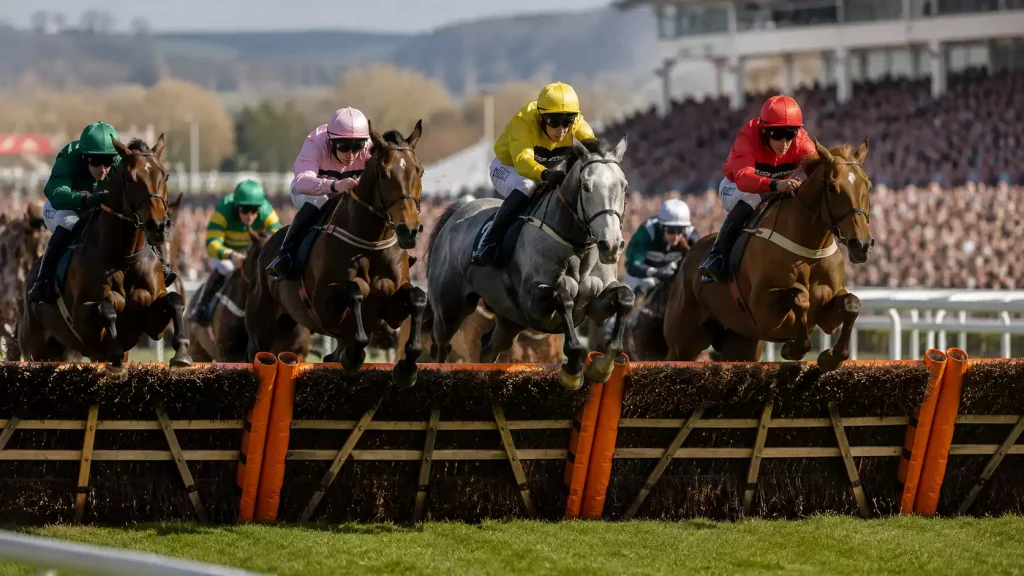
The One Race a Nation Bets On
My grandmother bet on the Grand National every year for sixty-one consecutive years. She bet on nothing else, ever. She did not know what a handicap was, could not have told you what “good to soft” meant, and once asked me whether they used the same horses every year. She picked her selection by name, by colour, occasionally by the look of the jockey, and she won often enough to keep coming back. The 2025 running saw an estimated £250 million wagered globally, with around 600 million viewers across 140 countries tuning in. About 49 % of British adults placed a bet on it that year, a number that runs all the way up to 73 % among the 55-plus age group. My grandmother was data – and so are you, statistically, if you have ever picked a horse for the National based purely on the name.
That sea of casual money is what makes the Grand National structurally different from every other race in the British calendar. The professionals do not move the market here in the way they move Saturday afternoon handicaps. Prices are pushed around by sheer weight of public money on certain favourites, by family-sweep momentum, and by the long shadow of a horse’s previous National runs. The serious punter has to read this race twice – once for the form, once for the public.
Extra places are each-way places: the place terms.
The Race Itself
The Grand National is run over four miles, two-and-a-half furlongs at Aintree, jumping 30 fences across two circuits of the National course. The fences are unique. Becher’s Brook drops away on landing in a way no other fence does. The Canal Turn requires a 90-degree change of direction immediately on landing. Valentine’s, the Chair, Foinavon – each fence has a name and a history, and several have been modified over the past two decades for safety reasons that I will get to. The maximum field is 34 runners, reduced from the historic 40 in recent years.
The race demands stamina, jumping ability, luck in running, and the right kind of jumping style – long-striding gallopers who can travel within themselves for the first circuit and respond at the elbow on the run-in. Speed alone does not win the National; nor does pure jumping ability. The combination is what makes the form book at this race read differently from any other handicap chase.
The Aintree fixture is run over three days, with the National itself on the Saturday afternoon. The 42,775 average daily attendance across the Festival is the third-highest of any British festival, behind only Cheltenham and the various Royal Ascot enclosures, but the Saturday alone draws far more than the three-day average – typically north of 70,000 on Grand National day itself.
The history is part of what every punter should know going in. Foinavon won at 100/1 in 1967 after most of the field came down at the small fence that now bears his name. Mon Mome won at 100/1 in 2009. Tipperary Tim won at 100/1 in 1928. The race has a tradition of producing outsiders precisely because the variables compound – any horse who jumps cleanly while a quarter of the field comes down at Becher’s has gained ground that better-fancied rivals cannot recover.
Place Terms and Special Cases
The standard each-way structure I have walked through in other pieces applies to the National with several specific twists worth knowing. The default place terms for a handicap with 16 or more runners are four places at one-quarter odds. Many bookmakers extend this to five or six places at the same fraction, and a few will run promotions paying out to seventh, eighth or even tenth place on the National specifically. Some firms offer one-fifth odds on extended places – a slightly different mathematical shape that pays out on more horses but at a steeper discount.
This is also one of the few races where bookmakers actively compete on place terms as a marketing exercise. A firm offering five places at one-quarter is straightforwardly better than a firm offering four places at one-quarter for the same horse at the same price, provided you genuinely believe the horse can finish fifth. The trap is treating extended place terms as a free upgrade. They are not free – the bookmaker is paying for the publicity benefit of being the “best terms” firm, and they are paying for it out of the same overround pool that funds the rest of their pricing. The headline win prices on the National are typically a touch shorter at firms with very generous place terms.
BOG – best odds guaranteed – is the third special-case area. Many operators exclude the Grand National from their standard BOG offer or apply it only above the regular SP, not above their enhanced morning prices. The interaction between BOG and the National’s special terms is one of the most-disputed customer-service issues at every running of the race, and the safest assumption is that BOG either does not apply or applies in a watered-down form. The detailed treatment of BOG is in the piece on how Best Odds Guaranteed actually works and where it does not apply.
Once-a-Year Punters: How to Bet Smarter
If the Grand National is the only race you bet on all year, here is the version of the form book that I would actually use, distilled from a decade of watching the public lose money on this race in identical ways.
Look at recent form on similar tests of stamina. A horse that has won or run well in a three-mile-plus handicap chase over the previous winter is showing the right kind of fitness profile for the National. A horse whose recent form is all over two-and-a-half miles is being asked a different question – sometimes that works, often it does not.
Check previous Aintree experience, but read it carefully. A horse that has run in the National before and finished – even if it did not win – has demonstrated the jumping ability and the temperament for the course. A horse that has refused or unseated at Aintree has shown the opposite. The cohort of National horses with previous course form is a smaller, more reliable sub-pool than the field as a whole.
The trainer’s record matters. A handful of training operations have dominated the National over the past two decades – Gordon Elliott, Willie Mullins, Lucinda Russell, the late Trevor Hemmings’s family of horses, and a rotating cast of specialist long-distance yards. A horse from a yard with multiple recent National finishers is a different proposition from a horse from a yard with no Aintree record at all.
Weight matters more than it does in a normal handicap. Heavy weights – 11 stone 5 pounds or more – have a poor recent record in the National. The handicapper is squeezing the top of the weights in a race where stamina is the binding constraint, and high-weighted horses have rarely won in the last twenty years.
The age sweet spot is roughly 8 to 11. Younger horses lack the experience and seasoning; older horses begin to lose the speed needed on the run-in even if they retain the stamina. The historical winning age range is concentrated in that four-year window.
One BGC executive captured the broader market backdrop in 2025 when commenting on the threat of unregulated competition: “These parasite operators don’t pay tax, don’t care about safer gambling, and do not contribute a penny to the levy.” The Grand National in particular is a race where the unregulated offshore market actively targets casual punters with prices that look better than the regulated market – and the protections you lose by betting there can matter more on this race than any other. Stick with a UK-licensed operator. The £250 million wagered globally on the race includes a meaningful share funnelled through unregulated channels, and the consumer protection gap is real.
The full picture is in our guide to UK horse racing betting basics.
History and Statistics: What the Numbers Say
The headline data on the National is striking. The 2025 OLBG/YouGov survey showed that 49 % of British adults placed a bet on the race that year – almost certainly the single largest one-race participation rate in British sport. The 73 % participation among the 55-plus age group is genuinely remarkable; most other betting products skew younger, but the National is the rare race where older punters dominate the betting public. Among 18 to 24-year-olds, the 19 % participation rate is much lower – the National is not, on the data, a young person’s race in the way fixed-odds football betting is.
The favourites do not win the National at the rate they win other handicaps. In a typical 16-runner handicap chase, the favourite wins around 30 % of the time and the top three in the market account for roughly 55 % of winners. The Grand National’s recent history shows favourites winning at a meaningfully lower rate – the field size, the fences, the trip, and the public-money distortion of the prices combine to compress the favourite’s edge.
This is not a recommendation to bet long shots blindly. It is an observation that the price of the favourite at the National tends to be shorter than the horse’s true probability of winning would justify, because casual punters pile in on the obvious choice. The same effect on a smaller scale appears across the wider market – the favourite-longshot bias documented in academic studies tightens noticeably on this race, with the shortest prices offering particularly poor value to the punter. The detail of the longshot-bias literature is well-worth its own treatment, which I have given in a separate piece for those interested in the broader pattern.
The drift in turnover across the wider racing industry – total betting turnover on British racing fell 6.8 % in 2024 and is down 16.5 % against 2022 – has not really touched the National. The race remains a betting phenomenon outside the normal market patterns. Whatever is happening to Wednesday afternoon Wolverhampton, the Grand National continues to draw new and returning punters in numbers that the rest of the racing calendar simply cannot match.
Why do favourites win the Grand National less often than favourites in other handicaps?
Three factors compound. The field size is large, which dilutes any individual horse"s chance and increases the role of luck in running. The fences are demanding, which means even top jumpers can come to grief on a single mistake. And the volume of public money piled onto market leaders by casual punters compresses the prices to a point where the favourite"s true probability is often shorter than its win probability would justify. The same horse in a Saturday handicap would typically be a longer price.
What is the maximum field size at the modern Grand National?
The maximum field at the Grand National is 34 runners, reduced from the historic 40 over the past few years as part of safety modifications introduced by the BHA and Aintree. The reduction sits alongside other changes – softer fence structures, modified take-off points, and a redesigned starting procedure – all aimed at reducing the incidence of fallers and injuries while preserving the unique character of the race.
The other great Flat-code equivalent of the Grand National’s once-a-year participation pull is the five-day meeting in mid-June that draws a different audience entirely – older, smarter on the form, but every bit as volume-driven on the headline races. I have unpacked that meeting in the practical guide to Royal Ascot betting.