
On-Course Betting at British Racecourses
Best Horse Racing Betting Sites – Bet on Horse Racing in 2026
 Available in US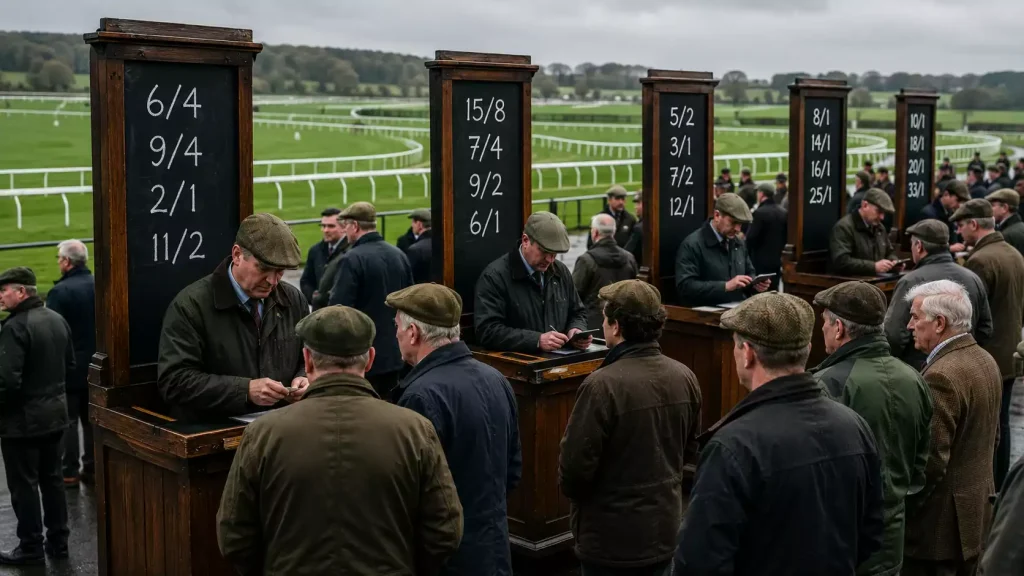
On-course betting is the historical foundation of the British market. Long before online apps, telephone accounts and starting price returns, the prices that mattered were the ones chalked on boards in the racecourse betting ring – and to a quiet but consequential degree, those prices still set the reference point for everything else. Understanding how on-course betting works is not nostalgia; it is an essential piece of context for any UK punter, because the morning prices you see on your screen ultimately trace back to the price discovery that happens trackside.
The betting ring is also a window into how the market actually behaves under pressure – money moving in real time, opinions hardening or breaking, weight of opinion shifting as horses circle in the parade ring before the off. Attendance figures show the model is not dying: total racecourse attendance reached 5.1 million in 2025, at an average of 3,526 spectators per fixture, and Q1 2026 added 696,611 attendees across 292 fixtures with a 4.6% year-on-year rise. People are still going. The ring is still working.
Which tracks you will meet: the major racecourses.
The Betting Ring and How It Functions
The betting ring is the part of the racecourse where licensed on-course bookmakers stand at their pitches, chalk prices on boards, and trade with the public for the duration of each race meeting. Each bookmaker has a designated pitch – a physical position in the ring – allocated through a long-standing seniority system administered by the Federation of Racecourse Bookmakers.
The ring opens roughly an hour before the first race. Bookmakers display their opening prices, and the early-morning trade begins. As money moves in on certain horses, those prices shorten; as money is laid out at unattractive prices, opening boards may move outwards. The dynamic is continuous and visible – anyone walking the ring can watch the prices change in real time as bookmakers respond to the weight of business at each pitch.
Hand signals – the older generation still call it “Tic-Tac” – were once the primary mechanism by which bookmakers communicated price moves across the ring without alerting the public. Mobile phones have largely replaced the signals for routine communication, but the cultural reference survives. The price moves that used to travel by gesture now travel by text, but the underlying market dynamic – bookmakers triangulating prices to limit exposure on heavily backed horses – is unchanged.
The starting price (SP) that off-course bookmakers settle bets at is derived from the on-course ring at the moment the race begins. A panel of SP returners records the available prices around the ring just before the off, and the agreed median becomes the official SP. Every off-course bet placed without a fixed price gets settled at this number, which is why what happens in the ring at 2:29pm directly determines the payout on a bet placed on a phone hours earlier.
This price-formation function is the under-appreciated piece of the on-course economy. The ring isn’t a quaint survival from another era. It is the price-discovery mechanism that underpins much of the wider UK racing betting market, even for people who will never visit a racecourse.
On-Course Versus Online Prices
The prices available in the ring can differ from those shown on your bookmaker app, and the differences are sometimes meaningful. On-course bookmakers operate without the overhead of a national bookmaker’s marketing, technology and compliance infrastructure, and their margins reflect that – overrounds in the ring are often tighter than equivalent online prices, particularly on favourites and second favourites where competition between ring bookmakers is most intense.
The trade-off is volatility. A horse priced 10/3 in the ring at 1:45pm may be 11/4 by 2:00pm if money moves in. The online market often lags this by minutes, particularly for less heavily promoted races, which means a punter with access to both can sometimes spot price discrepancies and back at the more favourable available number. The window is short and irregular, but it exists.
On-course bets also settle differently. Cash on the rails or at the pitch is paid out immediately after the weighed-in announcement, with no account-level paperwork or affordability check. For punters at higher stakes, on-course cash betting has become a meaningful alternative to online betting in the post-2024 affordability environment – the friction of online account checks doesn’t apply, and the transaction is completed within minutes of the race.
The flip side is that on-course bookmakers maintain their own list of limits, and a known winning punter can find their stakes restricted at the pitch just as they would be online. The ring is not a refuge from market discipline, but the discipline is applied differently – through bookmaker judgement and pitch-level decisions rather than through automated risk-management systems.
The full picture is in our guide to UK horse racing betting basics.
The Parade Ring as a Live Signal
The parade ring – the enclosed paddock area where horses walk and are mounted before the race – provides one of the few sources of live information that on-course punters have access to and online punters generally don’t. Watching horses circle for ten minutes before the off, you can pick up signals that the form book doesn’t carry.
The signals are often physical: a horse sweating heavily in cold weather, a horse refusing to walk forward, a horse showing the white of its eye, a horse already wound up and on its toes. None of these is definitive, and trained eyes vary in their reading of them, but the cumulative impression across ten minutes of observation is information that no card or model can replicate. The smartest on-course punters use the parade ring as a final filter – confirming a pre-race judgement or, occasionally, abandoning a bet they had intended to make.
The behaviour of the trainer and jockey before mounting provides another layer. A trainer giving sharp, animated instructions may be running a horse with high expectation. A trainer chatting casually may be running one without strong intent. A jockey climbing on with focused intensity is a signal; a jockey looking distracted is another. These are subtle reads, easy to over-interpret, but they form part of the texture of on-course betting that off-course punters never see.
The market often reflects parade-ring activity. Prices on horses that look well in the paddock will sometimes tighten in the final minutes; prices on horses that look poor will drift. Watching the price moves in the ring while simultaneously watching the horses in the parade is one of the genuine educational experiences of on-course punting – you can see, in real time, the connection between physical condition and market opinion.
Weighed In and the Settlement of Bets
“Weighed in, weighed in” is the racecourse announcement that confirms the result is official. It signals that the placed jockeys have weighed in within their declared weight tolerances and that no result-altering inquiries are pending. On-course bookmakers will not pay out winning bets before this announcement.
The weigh-in process exists to confirm that the jockeys finished the race carrying the weight they were supposed to carry. Each jockey is weighed before the race with their saddle and any allowed equipment, and weighed again after dismounting. If a jockey weighs in light – at less than their declared weight – the placing is potentially affected, and the result may be revised. If a jockey weighs in heavy by a small margin, this is usually acceptable; significant variations trigger stewards’ review.
For punters, the wait between the race ending and the weighed-in announcement is usually a minute or two. Bookmakers monitor for any stewards’ enquiries – the inquiry is announced before weighed-in if one is pending – and pay out only after the all-clear. The discipline matters because on-course bookmakers have no recourse if they pay out early on a result that subsequently changes.
The same protection extends to online bookmakers, but the experience is different – bets settle automatically once the result is confirmed by the integrity feed, usually within seconds of the weighed-in announcement at the course. The synchronisation between on-course and off-course settlement is the back-end plumbing that holds the British betting market together.
Britbet and Pool Betting On-Course
Alongside the fixed-odds bookmakers in the ring, every British racecourse offers pool betting through Britbet – the pari-mutuel operator that succeeded the Tote on-course in 2018. Pool betting works differently from fixed-odds: instead of taking a price, you contribute to a shared pool, and the payout is determined after the race by the total pool divided by the winning units.
The Britbet markets at racecourses include the Win pool, the Place pool, the Forecast and Tricast pools, and the various multi-leg pools including the Placepot and Jackpot. The popularity of pool betting on-course is concentrated around the larger meetings, where the bigger pools produce more competitive dividends and the bigger crowds drive higher participation.
Pool betting works particularly well for casual on-course punters because the unit stakes are small, the rules are straightforward, and the payout – while variable – doesn’t depend on shopping for the best price. A £2 Placepot ticket gives an afternoon’s involvement across six races without needing to study each race individually. The format suits the rhythm of the day at a racecourse better than fixed-odds punting for many casual visitors.
For the broader picture of which British racecourses host these markets and how their track characteristics shape the racing they produce, see our overview of the major UK racecourses.
FAQ
Are on-course bookmakers still regulated under the same UK Gambling Commission framework as online bookmakers?
Yes. On-course bookmakers are licensed under the same regulatory umbrella as off-course operators, though the specific licensing conditions differ. They are subject to integrity rules, anti-money laundering requirements and customer protection standards. The key practical difference is that on-course cash transactions don"t trigger online-style affordability checks at the deposit threshold level.
Can I bet on races at other meetings from the on-course betting ring?
Some racecourses host SIS-screen areas where you can bet on racing at other meetings, but the prices and product offering vary. The main betting ring activity is focused on the races being run at that course on that day. Off-course betting is usually available through the on-course branches of major national bookmakers if you want to bet on other meetings.
What happens to my on-course bet slip if I lose it?
Cash on-course bets are bearer bets – the slip is your only evidence of the wager. Lose the slip and you typically cannot collect winnings, even if the bookmaker remembers taking the bet. The smaller bookmakers may make discretionary exceptions for known regulars, but this is not guaranteed and should not be relied on. Keep slips safe until you"ve collected.
Why the Ring Still Matters
The on-course market remains the primary price-discovery mechanism for British racing, even in an era when the overwhelming majority of bets are placed online. The starting price you see on your account, the morning prices the off-course bookmakers display, the in-running prices on the exchange – all of these are anchored in some way to what happens in the ring on the day. Spending an afternoon walking the ring, watching the prices move, listening to the bookmakers and observing the parade is one of the most educational experiences any UK punter can have. The whole market makes more sense once you’ve seen it work in its physical, original form.